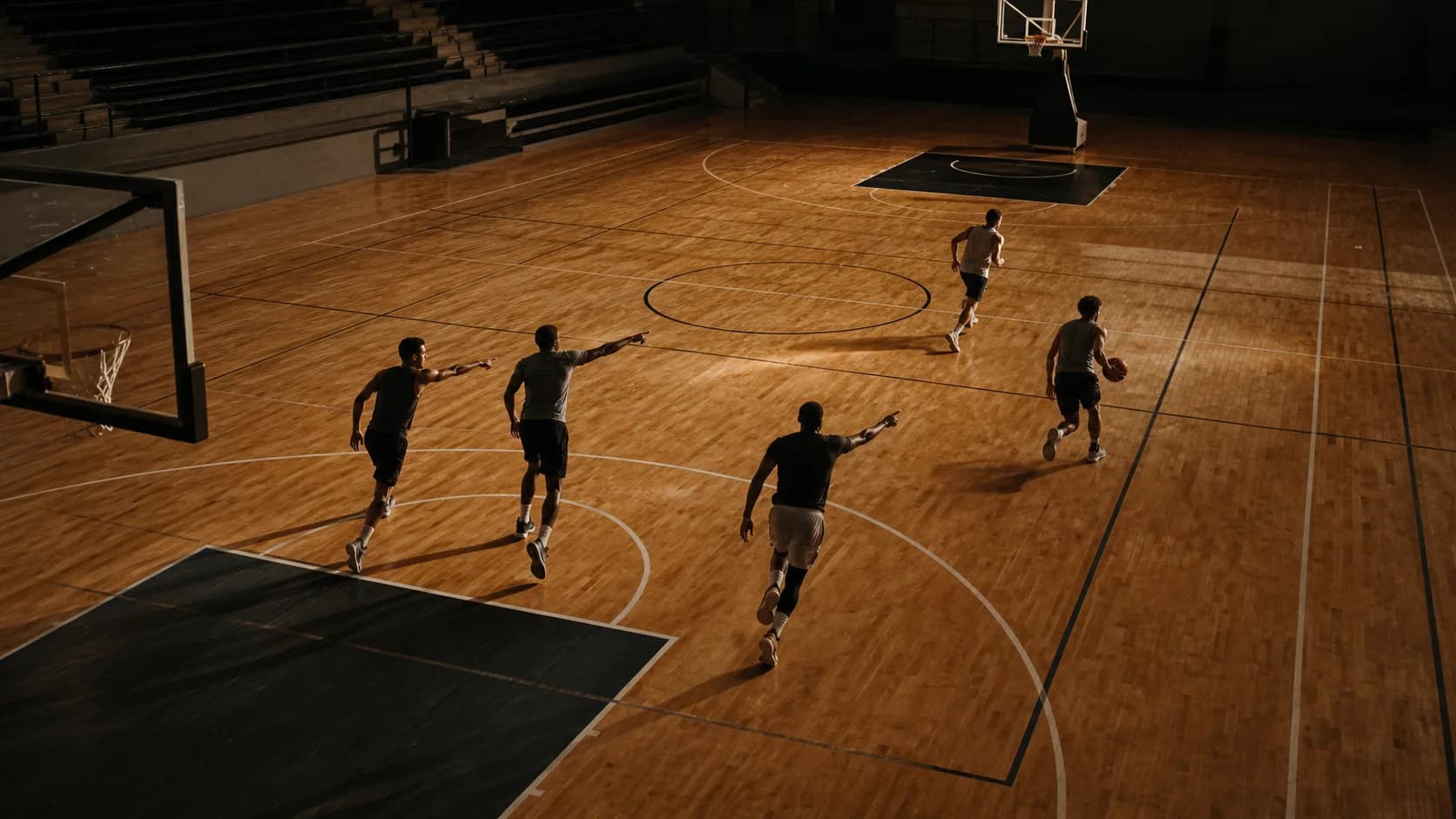
Most easy baskets in a game come in transition, and almost all of them come from breaking one rule: matching up before the rim is protected. Good transition defense is not complicated, but it is unforgiving about order. Protect the basket, stop the ball, then find your man. Reverse those steps and you give up layups. Follow them and you turn a fast break into a normal half-court possession. The whole thing is decided in the first three to five seconds after the ball changes hands. For a deeper look at the concepts, see transition defense principles every coach teaches, and for where to be off the ball, positioning IQ.
How do you defend in transition? Sprint back in a fixed order: protect the rim, stop the ball, match up. The deepest player back sprints straight to the paint to take away the layup, no matter whose man is running. The next defender back stops the ball near half court to slow the break. Everyone else sprints to the level of the ball and picks up the most dangerous open players, usually shooters filling the wings. The order never changes. The rim is the first thing you protect because a layup is the worst outcome, and a contested jumper is a win for the defense.
The trigger is the shot or the turnover, not the outcome. Defenders who wait to see if a shot goes in are already a step behind. The habit is to turn and sprint the instant the ball goes up or changes hands, before you know the result.
Why protect the rim before matching up? Protect the rim first because a layup is a guaranteed two points and matching up first leaves it open. When defenders chase their own assignments across the floor, no one is home at the basket, and the offense simply throws it ahead for a dunk. By sending the first player back straight to the paint, you take away the highest-value shot in the game and force the offense to settle for something harder: a pull-up, a kick-out, or a reset into the half court. The defender at the rim is not guarding a person yet, he is guarding the basket. Assignments get sorted after the paint is safe.
This is why coaches say match first and get scored on, protect the paint first and give up shots you can close out to. A team that guards the rim first turns transition into a series of contested perimeter looks, which is exactly what the defense wants.
Worked example: 3-on-2 fast break Offense grabs a rebound and pushes with three players against two defenders back. Here is how the two defenders handle it correctly.
The two defenders do not each pick up a man, which would give up a wide-open third player. Instead they play top-and-bottom, or tandem. The bottom defender sits in the paint and protects the rim. The top defender meets the ball at the free-throw-line extended and stops it, forcing the ball-handler to pick up the dribble or pass. When the ball-handler kicks to a wing, the top defender slides to guard that pass while the bottom defender bumps up to take the ball, and the two rotate as a unit, always keeping one man on the ball and one at the rim. They are stalling, buying the second or two it takes for the third and fourth defenders to sprint back and even the numbers. The mistake would be the bottom defender leaving the paint early to guard a wing, which opens the middle for a layup. Hold the paint, contain the ball, and let help arrive.
What is each defender's job in transition? Everyone has a role, and knowing it before the break starts is half the battle. Here is the standard assignment order as the ball comes at you.
| Priority | Defender | Job |
|---|---|---|
| 1 | First man back | Sprint to the paint, protect the rim |
| 2 | Second man back | Stop the ball at or above half court |
| 3 | Next defenders | Sprint to the level of the ball, take open wings |
| 4 | Trailers | Find shooters, communicate switches, match up |
Two habits make this work. The first is talking. The defenders yell who has the ball, who has the rim, and who is switching, because in a scramble nobody has time to figure it out silently. The second is sprinting to the ball, not to your man. You run to the spot the defense needs filled and pick up whoever is there, then sort the true matchups once the possession slows. Chasing your specific assignment across the floor is how the rim ends up empty.