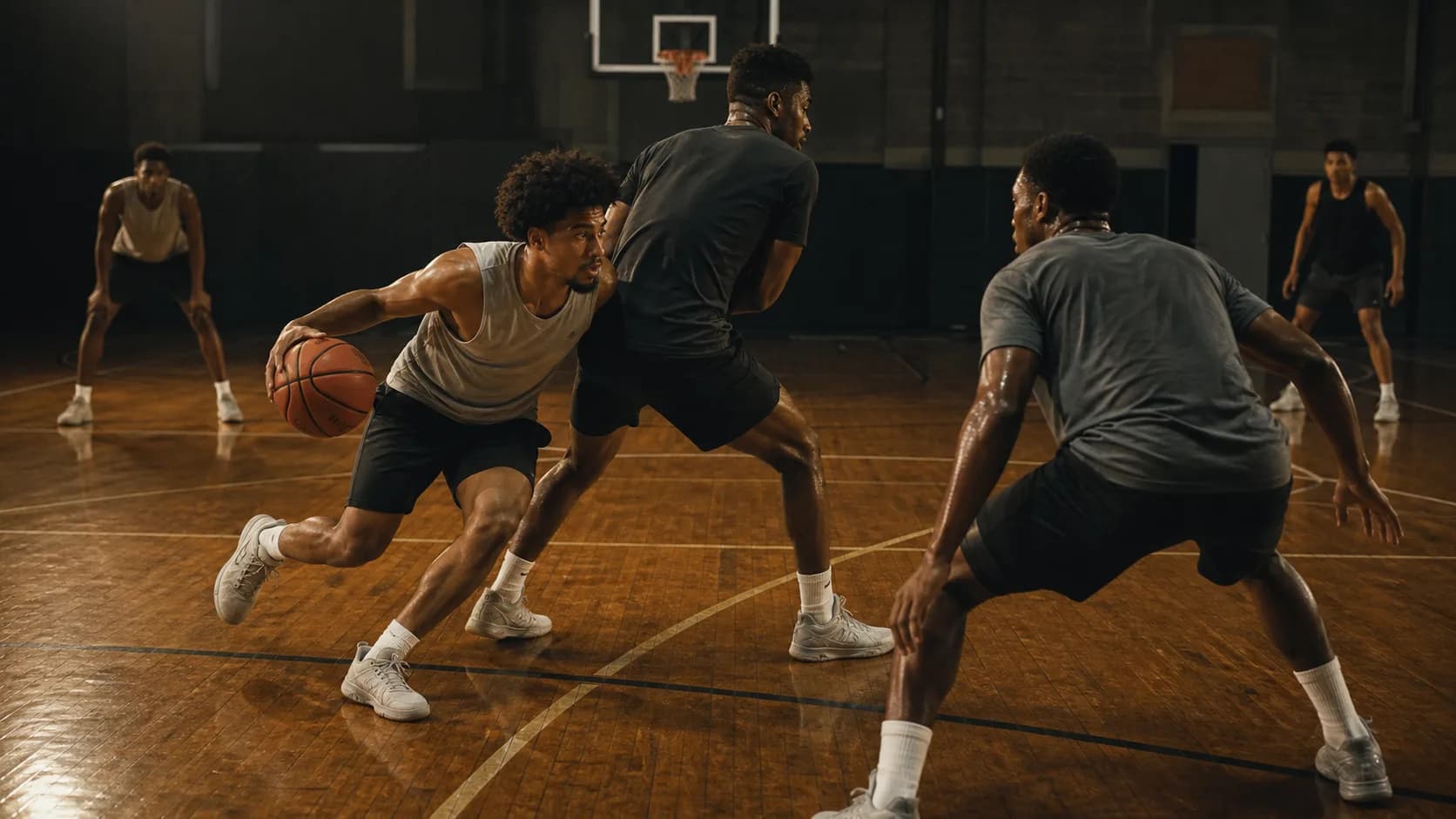
A blitz is the defense's way of saying it respects your ball-handler too much to guard him one-on-one. Two defenders jump the pick-and-roll and try to speed the guard up. The good news is simple math: two defenders on one player leaves four offensive players against three defenders everywhere else. Beating the trap is not about escaping it with the dribble. It is about getting off the ball fast and playing in the numbers advantage the defense just handed you. If you want the full menu of coverages this fits inside, start with pick-and-roll coverages explained and how to read a defense.
How do you beat a blitz on the pick-and-roll? Get off the ball early to the short-roll man and let him make the next read. When both defenders commit, the ball-handler takes one or two retreat dribbles to buy a passing angle, then hits the screener as he rolls a step past the trap into open space. That screener now faces a 4-on-3. He does not have to score himself. His job is to catch, read the low defender, and either finish or pass to the open shooter the defense abandoned. Every extra dribble you take inside the trap is time the defense uses to recover.
The order of operations matters. First priority is the pass out, not the split. Splitting two NBA-level defenders is a highlight, not a plan. Second, the receiver plays downhill, keeping the ball moving toward the rim so the defense has to keep rotating. Third, the last pass finds the man the trap left open, usually a corner or weak-side shooter.
What is a short roll and why does it beat the trap? The short roll is the screener rolling only partway to the rim, stopping in the space just behind the trap around the free-throw line, then catching the ball in the middle of the floor. It beats the trap because it puts a decision-maker at the center of a 4-on-3 with the whole defense behind him. Instead of rolling all the way to the block where a help defender waits, the screener parks in the soft spot the blitz creates and becomes a passer as much as a finisher. A big who can catch and make one good read out of the short roll makes a blitz almost unplayable for the defense.
The read for the short-roll man is a quick two-part question. Is the low defender stepping up to stop me? If yes, someone behind him is open, so pass. If no, the rim is there, so finish. That is the entire job, and it is why teams love bigs who pass. A screener who can short-roll and hit the weak-side corner turns the defense's aggression into open threes.
Worked example: middle pick-and-roll gets blitzed Guard brings the ball to the top of the key. The screener sets a ball screen at the left slot, and both defenders jump out to trap the guard just above the arc. Here is the read, step by step.
The guard sees two chests, so he takes one hard retreat dribble to the middle of the floor to open the passing angle, and delivers the ball to the screener, who has short-rolled to the nail, the middle of the free-throw line. That screener catches facing the rim with a 4-on-3. The weak-side low defender, the one guarding the far corner, has to make a choice: step up to stop the ball or stay home on the corner shooter. If he steps up, the screener throws the skip or the swing to the now-open corner. If he stays, the screener attacks the rim off two feet because no one is there. Meanwhile the ball-side corner has lifted to the wing so the guard who threw the pass has an easy relocation for a return kick-out. The whole sequence should take under two seconds. The moment it slows down, the trapping defenders sprint back and the advantage is gone.
Where should everyone stand to beat the trap? Space so every pass out of the trap is short and every receiver is a threat. The reliable rule is that players adjacent to the ball lift and players away from the ball stay wide for the skip. Below is the standard blitz spacing and the read each spot owns.
| Spot | Where to be | The read you own |
|---|---|---|
| Ball-handler | Retreat one dribble, keep the pass live | Hit the short roll first, never split |
| Screener | Short-roll to the nail or free-throw line | Finish 4-on-3, or pass to the open man |
| Ball-side corner | Lift to the wing | Relocate for the return kick-out |
| Weak-side wing | Slide toward the middle | Catch-and-shoot or drive a closeout |
| Weak-side corner | Stay wide and deep | Be ready for the skip pass three |
Two spacing mistakes kill more possessions than the trap itself. The first is the ball-side corner standing still in the corner, which gives the trapped guard no short outlet and forces a risky cross-court throw. The second is a screener who rolls all the way to the block instead of stopping short, which lets the low help defender guard two players at once. Fix the spacing and the 4-on-3 plays itself.