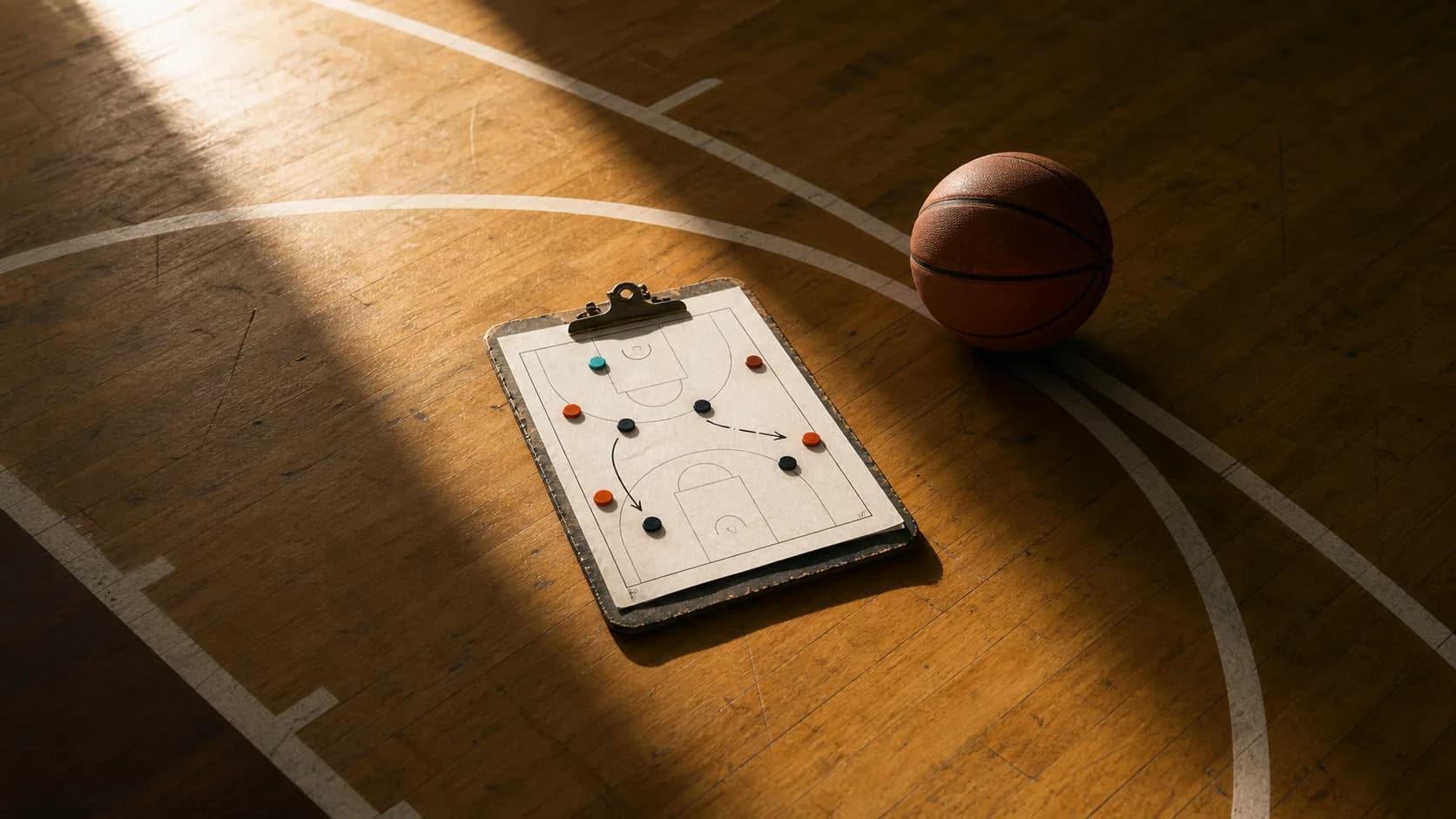
Alabama, Illinois, Oklahoma (classes 6A to 3A) and Florida all start 2026-27 under a new 35-second shot clock requirement. New Jersey approved one in May 2026 by 170 votes to 166, starting in 2027-28. For most possessions the clock changes nothing, because most high school possessions end long before 35 seconds. What it changes is the possessions that decide close games: the last 40 seconds of every quarter, late-game fouling decisions, and how much a press is worth. Those are coaching decisions, and they need to be made in September, not at the first timeout in December.
| State | What changes | Levels | Status |
|---|---|---|---|
| Alabama (AHSAA) | 35-second shot clock | Boys and girls | Starts 2026-27 |
| Illinois (IHSA) | 35-second shot clock, backboard-mounted in the primary gym | Required for varsity, optional below | Starts 2026-27 |
| Oklahoma (OSSAA) | 35-second shot clock, one-season trial | Mandatory 6A to 3A, optional below | 2026-27 only, then reviewed |
| Florida (FHSAA) | 35-second shot clock | Boys and girls | Starts 2026-27 |
| New Jersey (NJSIAA) | Shot clock approved 170-166 | Mandatory varsity, optional JV and freshman | Starts 2027-28 |
NFHS reported that 32 states used a shot clock in some form in 2025-26, so coaches in these states are catching up to most of the country, and there is plenty of experience to borrow from. Checked 18 September 2026 against the association announcements and coverage listed in the sources.
The rules you actually need to know
NFHS Rule 2-14 has let each state association adopt a 35-second clock since 2022-23, following guidelines designed to keep states consistent. The core ones:
- Full reset on a change of possession. The clock returns to 35 when the other team establishes control.
- Kicked or fisted ball. The guidelines suggest a full reset, but states may choose a partial reset. Read your own state's adoption document.
- Equipment. The guidelines call for two shot-clock displays connected to a horn that sounds different from the game-clock horn, plus a backup timing device such as a stopwatch at the table if the clock fails.
Two 2026-27 NFHS changes interact with the clock at the end of quarters. Under Rule 5-9-5, at least 0.3 seconds must come off the game clock when the ball is touched inbounds in the final 59.9 seconds of a quarter, where the clock shows tenths. And a new note to Rule 5-10-2 lets officials use a silent count to correct a clock that was not started or stopped properly. In a first season with a new operator at the table, expect corrections, and know how your crew will handle them.
Change 1: You need a late-clock offense, and it has to be practiced
Most high school offenses have never needed an answer for "10 seconds left and nothing open." Now every team needs two or three.
Keep them simple and give them names your players can hear over a crowd:
- A high ball screen for your best creator into an empty side. The single most reliable late-clock action at every level with a clock, because it forces two defenders to make a decision quickly.
- A handoff into a drive. Useful when your best creator is not your best ball handler.
- An isolation from the elbow or wing for the player who can get a shot off against a set defense.
Then set two rules. The ball is in your creator's hands by 10. The shot is up by 3. What you are trying to prevent is the panic pass at 2 seconds to the player who never shoots.
Practice it the only way it transfers: scrimmage with the clock running every day for the first two weeks, and run "short clock" possessions that start with 10 or 12 on the display. The first live possession where the horn goes off should not be in a real game.
Change 2: Defense gets a new way to win a possession
Before the clock, a good defensive possession could only end in a miss or a turnover. Now it can end with the offense taking the shot it did not want at the end of the clock, and across every level of basketball that plays with a clock, those shots are among the least efficient on the floor.
That changes how you defend the back half of a possession:
- Take away the reversal after about 15 seconds. Make the offense start its late-clock action from one side.
- Load up on the creator once the clock hits 10. You now know who gets the ball. Show a second defender early.
- Switch late, not early. A switch at 25 seconds gives the offense time to hunt the mismatch. A switch at 6 does not.
Change 3: The end of every quarter becomes arithmetic
Without a clock, the last possession of a quarter was simple: hold for one. Now, if more than 35 seconds remain, you cannot hold for one shot. The shot-clock horn will beat the quarter horn.
That opens the two-for-one:
| Game clock when you get the ball | What to do |
|---|---|
| More than about 50 seconds | Run normal offense |
| About 40 to 50 seconds | Look for a quick, good shot so the opponent's full possession still leaves you the last one |
| About 35 to 40 seconds | Decide: a quick shot for two possessions, or hold the ball for one with the shot clock nearly matching the game clock |
| Under 35 seconds | The game clock governs. Hold for the last shot as you always have |
The exact thresholds depend on your team: how fast you get into offense, and how long you need for a good final possession. Work your own numbers out in practice and put them on the card your assistant holds, because nobody computes this well at the end of a loud quarter.
Change 4: Protecting a lead, and chasing one
This is the biggest strategic shift, and it cuts both ways.
The leading team can no longer hold the ball. Every late-game possession has to produce a shot. So you need a "clock" set: 25 to 30 seconds of spacing and patient movement that still ends in a decent shot. Ball screens late in the clock, not a stall.
The trailing team gets an option it never had. Without a clock, a team down two possessions in the final minute and a half had to foul almost immediately, because the leader could hold. With a 35-second clock, you can sometimes defend one full possession, get a stop, and still get the ball back with time to score. The earliest point at which you must foul moves later. Where exactly depends on the margin, your timeouts and your free-throw shooting, so settle it in practice, not in the huddle.
In Oklahoma there is an extra wrinkle. Coverage of the OSSAA vote reported that shot-clock violations would not be enforced during the playoffs. If that holds in the current manual, Oklahoma coaches need two end-of-game plans, one for the regular season and one for February.
Change 5: Your press is worth more than it used to be
Every second the offense spends breaking pressure is a second it no longer has in the half court. A press that burns 8 to 10 seconds leaves 25 to 27 seconds to run half-court offense against a set defense, which pushes more possessions into late-clock territory where shots get worse.
So a press no longer has to create turnovers to be worth running. Pressure that only slows the ball up now has a second payoff. If you have the legs for it, and our guide to breaking a press shows the other side of it, expect more teams in these states to extend their defense this season.
Change 6: Zone offense needs a deadline
Teams that beat zones with patience, eight and nine passes until the gap opens, now need a point in the possession where they attack. A good rule is to have the ball in the high post or the short corner by 15 seconds. Zone defenses that sit and wait have a new tool too: extend, force the extra pass, and let the clock do some of the work. For the offensive answers, see how to beat a zone defense.
Change 7: The athletic director's checklist
Illinois set the sharpest rule in the group. A school may not host a varsity game if a shot clock is not installed or not properly mounted on the backboard in its primary gym. The host has to find another facility or let the opponent host, and if neither works, the home team forfeits.
Everywhere, the practical costs are the same three things:
| Item | What to plan for |
|---|---|
| Equipment | Florida's association estimated $3,000 to $5,000 per school for shot clocks |
| Operator | Someone trained at the table every game, often a paid position |
| Backup | A stopwatch and a procedure for a clock failure, per the NFHS guidelines |
New Jersey's athletic directors raised exactly these concerns during their vote: the equipment and a trained operator for every game. Budget both before the first scrimmage, and run that scrimmage with your real operator.
What to scout now that there is a clock
A shot clock adds new questions to every scouting report. Who gets the ball when the clock hits 10? What is their late-clock action, and which side of the floor do they prefer to run it from? Do they settle for a contested pull-up or drive? In a close game those answers decide possessions, and you can usually find them in the last few minutes of two or three recent games.
The college and professional game has played with a clock for decades, which makes it the best library of late-clock solutions available. HoopBrief turns that library into answers: ask how elite creators attack a set defense in the last ten seconds, or how to guard a scorer who gets to his spot late in the clock, and you get a structured, scouting-style read from public statistical and play-by-play data. The free matchup scout shows the format with no account.
For a full season of late-game planning, Starter is $9.99 a month for unlimited questions with attack and guard plans, and Pro is $99 a month for all 12 coaching lenses and unlimited saved reports, so your end-of-game card is there every week. See plans and get started. To build the rest of your preseason around the change, start with our season practice plan template.