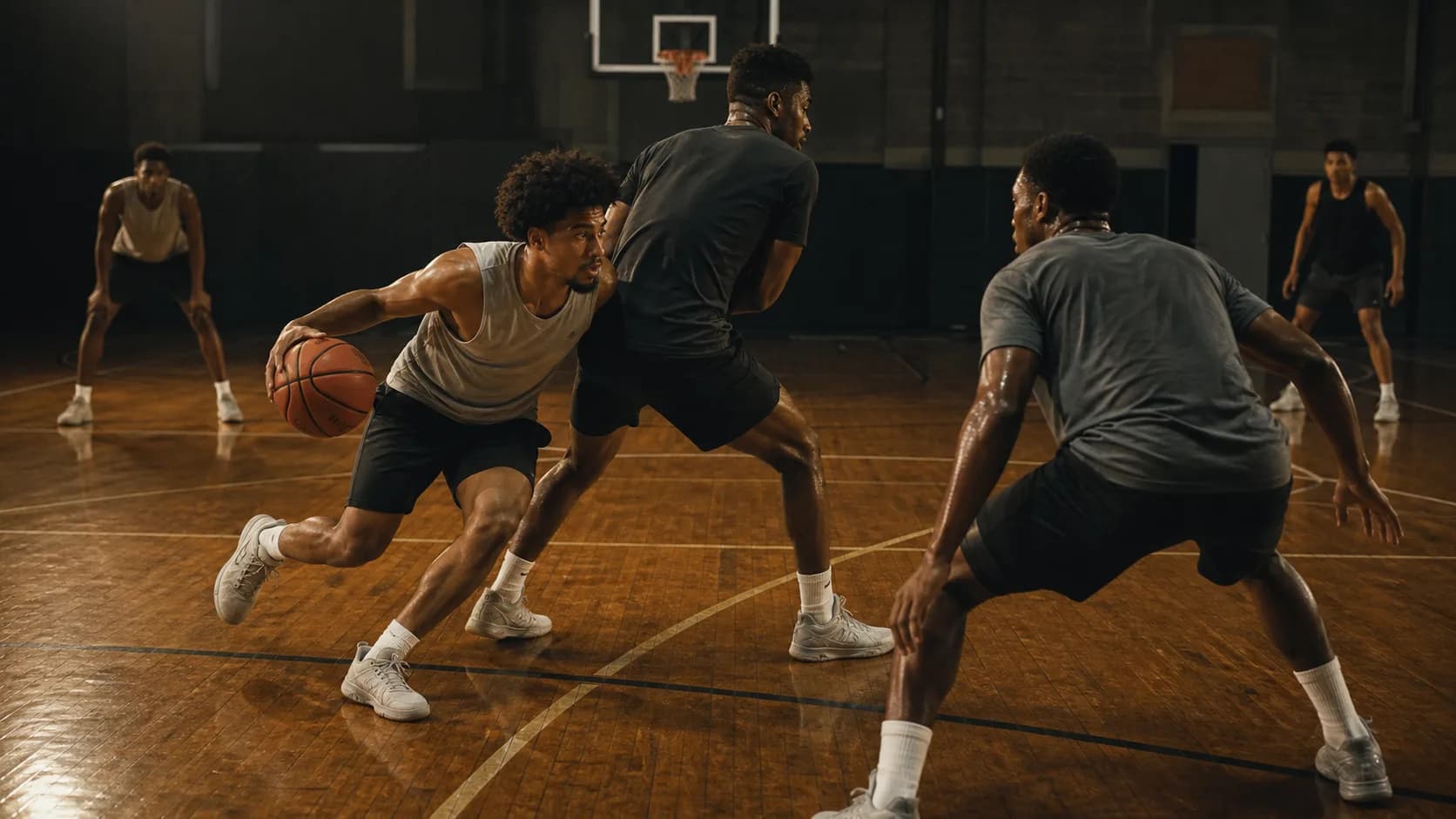
- ball
- defender
- offense
- the read
Drop coverage is the most honest defense in basketball. It tells you exactly what it will give up before the ball ever crosses half court: the mid-range jumper, in exchange for a walled-off rim and covered corners. Beating it is not about being clever. It is about calmly cashing the shot the defense is handing you, and knowing when the big's decision opens something better.
This is the offense-side companion to our pick-and-roll coverages breakdown, which explains what drop, switch, blitz, and ICE are from the defense's chair. Here we flip it: you are the ball-handler and the screener, and the big is sitting back.
How do you attack drop coverage?
Attack the gap the drop creates and read the big's depth. If the screener's defender sits deep at the dotted line, the pull-up at the nail is a free 12-to-16-foot look, so take it with rhythm. If the big steps up to the level of the screen to challenge, that lift is your trigger to feed the pocket pass to the roller diving behind him. The two reads are linked: the pull-up punishes the deep drop, and the pocket pass punishes the aggressive one.
Pace is the whole thing. A ball-handler who sprints into the screen and then decelerates on the catch of the dribble reads the big far better than one who drifts. The deceleration buys the beat you need to see whether the big is at the dotted line or stepping up.
The three core reads
Drop gives you a decision tree, not a single answer. Here is the read for each thing the defense does.
| What the drop big does | Your read | Why it works |
|---|---|---|
| Sits deep at the dotted line | Pull-up at the nail or elbow | The 12-16 ft window is uncontested |
| Steps up to the level of the screen | Pocket pass to the roller | The roll is now behind the coverage, 4-on-3 |
| Sinks with the roller to the rim | Skip to the weak-side corner | The low man had to help, so his man is open |
| On-ball defender goes under the screen | Screener re-screens, or immediate pull three | Space to launch before the chase recovers |
The mistake players make is picking a read before they come off the screen. The coverage tells you the answer; your job is to hold your dribble one beat longer and let it.
A worked example
Picture a high pick-and-roll, ball-handler at the top, screener setting a pick on the right slot. The big is in drop at the level of the dotted line, and the on-ball defender chases over the top. The ball-handler comes off with pace and gets two feet into the paint at the elbow.
Read one: the big holds his depth to protect the rim. The ball-handler rises into the pull-up right there at the nail. Clean look, exactly what drop offered.
Read two: the big lurches up to contest the pull-up. Now the roller is diving into the space the big just vacated. The ball-handler drops the pocket pass on the bounce, and the roller catches at the foul line in a four-on-three. From there the roller reads the low man: if he tags the roll, the weak-side corner is open on the skip; if he stays, the roller finishes.
Read three: the low man pre-rotates early to tag the roller before the pass arrives. That is your skip to the strong-side or weak-side corner, because a defender who left the corner cannot recover to a good closeout in time. This is where knowing the personnel matters, and where studying how to exploit a matchup turns a good read into a great one.
The screener's job
The screener is not a bystander after the pick. His read of the big's depth is what turns drop into a numbers game. If the big steps up to the ball, the screener dives hard to the rim, because the space behind the big is now a four-on-three. If the big stays deep, the screener short-rolls to the foul line and becomes a decision-maker in the middle of the floor, reading the low man just like the ball-handler read the big.
A screener who also handles and passes, the modern short-roll big, makes drop nearly unplayable, because he punishes both the deep drop (short-roll playmaking) and the aggressive one (rim dive). Our breakdown of handoff and short-roll reads covers how to build that second-side advantage on purpose.
When drop is actually good against you
Drop wins when you refuse the shot it offers. A ball-handler who will not shoot the pull-up lets the big sit deep with no consequence, which erases the pocket pass because the big never has to step up. Late in the clock, drop also eats time: the coverage is designed to make you settle for a contested two as the shot clock dies. The counter is to attack early in the possession, before help is set, and to make the first pull-up so the defense has to change coverage.
Want the read for a specific big who plays drop? Ask HoopBrief for a scouting breakdown of how any NBA center defends the pick-and-roll, and where his drop is soft.