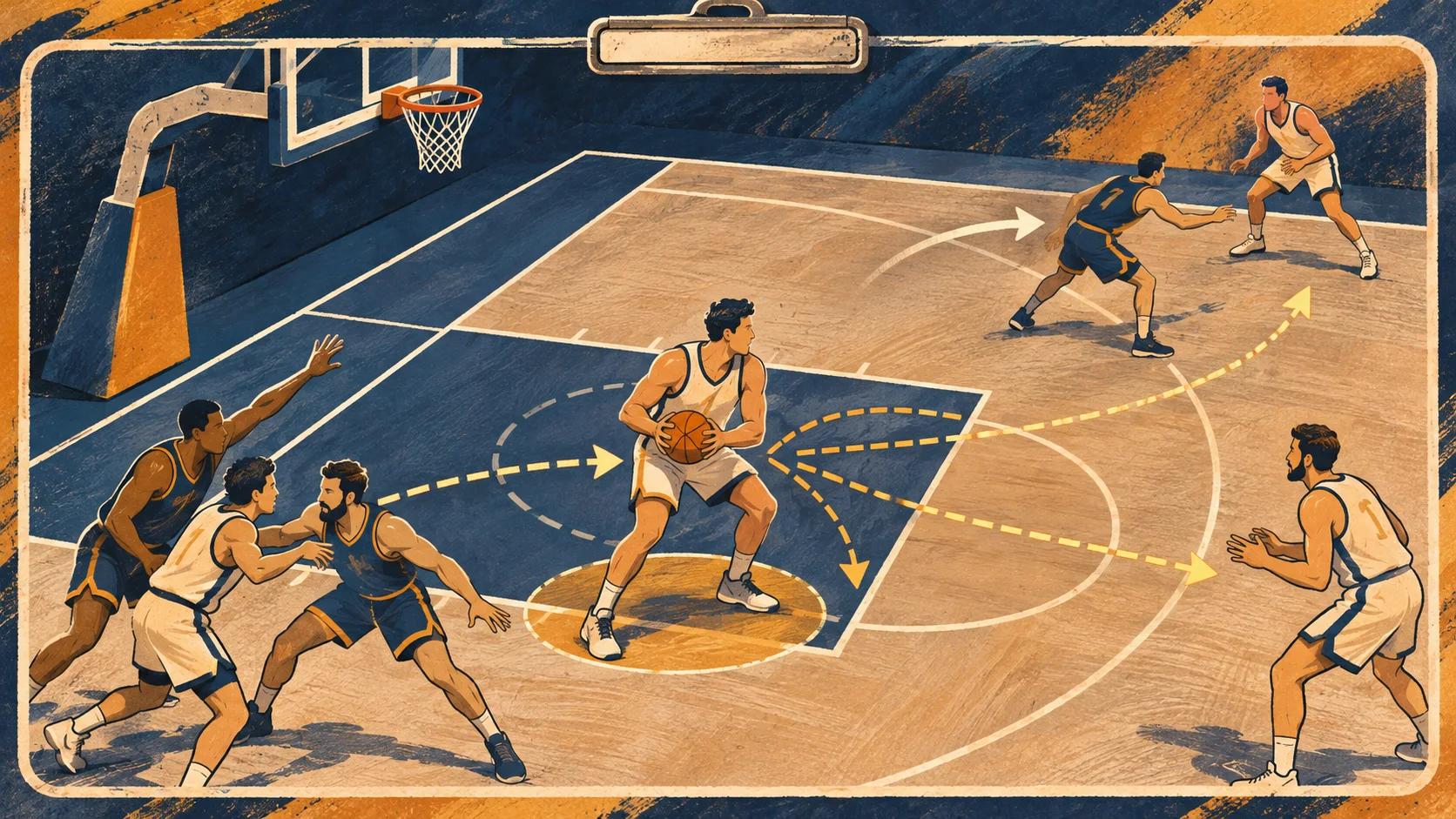
A short roll is a screener's move into a receiving area between the original screen and the basket. Against pressure on the ball handler, that catch can put the screener behind two defenders. The advantage still depends on the catch, spacing and next rotation.
For a useful scout, ask three questions: where does the screener receive the ball, which defender stops the next drive, and which teammate becomes available? This guide is a study framework for European basketball, not a statistical claim about a current league or club.
Start with the catch location
Pause as the screener receives the pass. A catch near the foul line presents different choices from a catch near the sideline. Record whether the receiver is facing the basket, moving into the catch or reaching backward for the ball.
Do not blame a slow decision entirely on the receiver if the first pass arrives late or outside the receiver's balance. Delivery and decision are separate parts of the possession. A short roll that looks open on a diagram can become crowded by the time the ball arrives.
Name the screener's available lane in ordinary language. “Middle lane open, helper stepping from the corner” is more precise than “four on three.” A numerical advantage can exist without an easy pass or finish.
Locate the defender responsible for the next stop
After the catch, move your attention away from the ball for a moment. Which defender is closest to the basket? Who is responsible for the corner? Is a higher defender moving down to replace the first helper?
The first defender to commit often determines the next read. But commitment must be observed, not guessed from a still image. A defender can show help and recover, or hold a position that discourages a pass without leaving a teammate completely open.
Use a clip log:
| Moment | Observation to write | Question for the receiver |
|---|---|---|
| Pass arrives | Catch location and body position | Can I face the rim immediately? |
| First helper moves | Starting spot and direction | What space did that defender leave? |
| Second defender rotates | Which passing lane closes | Is the next pass still available? |
| Possession continues | Finish, extra pass or reset | Was the decision early enough? |
The table does not prescribe one answer. Your roster and team rules determine which options are realistic.
Compare the shot, drive and pass
An open lane may invite the receiver to finish. A defender moving toward that lane may create a pass. A defense that recovers without overcommitting may require a controlled reset rather than a forced highlight play.
Watch the receiver's eyes and balance. If the player looks only at the rim, the weak-side read may arrive late. If the player decides to pass before reading the helper, a defender can anticipate the delivery. The practice task is to recognize the cue before choosing the action.
A good film note separates the recognition from the result: “Saw the helper leave the corner, but released the pass after the rotation arrived.” That suggests timing work. “Bad pass” leaves the coach with less to teach.
Practice one rotation at a time
Begin with a guided catch and one helper. Let the helper choose between protecting the rim and staying attached to a receiver. The short roller should identify the choice and act while balanced.
Then add a second defender rotating toward the first pass. The receiver now has to consider whether the advantage belongs to the next teammate. Keep the spacing consistent enough that the athlete can identify what changed between repetitions.
Use the team's terminology. If your staff uses different words for the same coverage, agree on the assignment before debating the label. Stop and reset when the players do not know which defender owns which space.
Prepare a specific HoopBrief question
Bring your own observations to HoopBrief Ask: “On our clips the screener catches near the foul line after two defenders pressure the guard. The corner defender steps toward the lane. Explain the next rotation and a progression for the receiver.” Ask the response to separate observed facts from possible counters.
HoopBrief's NBA data does not verify your European opponent's short-roll frequency, passing skill or preferred coverage. Use the free NBA scout to evaluate the product on supported players, read the methodology, and verify any proposed assignment against your own film and coaching system.
The useful output is a question or practice constraint you can test. If that workflow becomes part of recurring preparation, review the current plans for access and saving features. A paid plan does not turn an unverified opponent assumption into a fact.
Does every short roll create an advantage? No. Poor spacing, a delayed pass or quick recovery can erase it. Study the catch and the defenders' positions before naming the advantage.
Should the receiver always make an extra pass? No. The open finish, available passing lane and team's instructions determine the decision. An extra pass is useful when it preserves or improves the advantage.
Basis for the teaching framework
The FIBA WABC Level 2 manual discusses coordinated team help behind ball screens. The worksheet and practice progression here are HoopBrief editorial exercises, not a claim that FIBA endorses this report or a universal coverage.