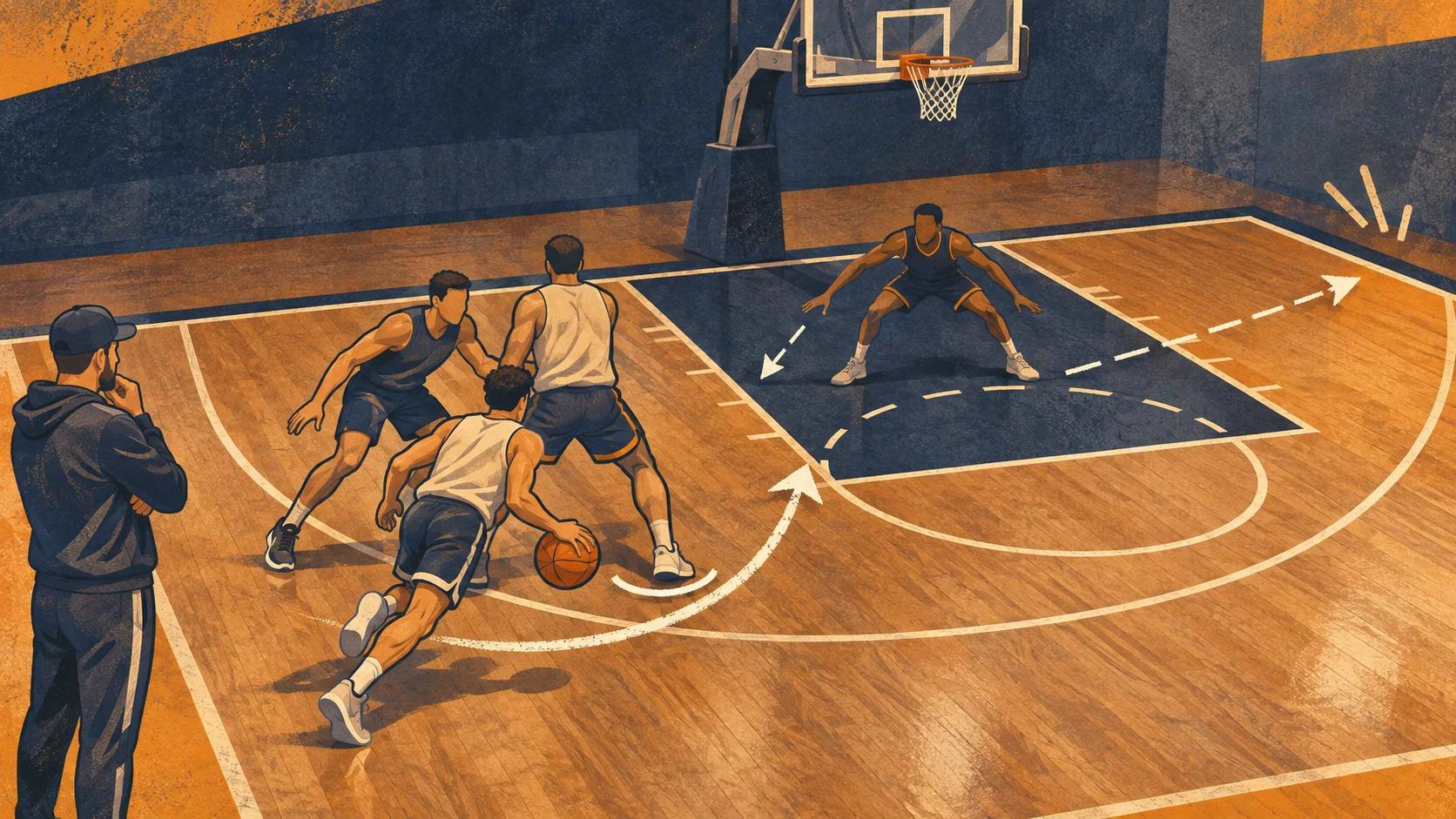
An empty-corner pick and roll leaves the corner on the ball side unoccupied. That changes the nearby help picture, but it does not remove help from the possession. Before building a workout around the action, identify the on-ball defender, the screener's defender and the first helper who can reach the lane.
Use three reads: how the guard gets around the screen, what the big takes away, and where the next helper comes from. Rehearse the decision you observe rather than copying a difficult finish from a highlight.
Read one: can the guard create the intended angle?
Pause before the screen makes contact. Record the screen location, the defender's top foot and the ball handler's route. If the guard drifts away from the screen, the possession may never create the advantage the workout assumes.
Ask whether the guard uses the screen, rejects it, or waits for a different angle. Each choice can be appropriate in context. The important question is which cue prompted it. “Go faster” is an incomplete correction when the route is the problem.
For a controlled practice repetition, ask your coach to define the screen location and the defender's allowed choices. Start at a pace where the guard can explain the cue. Increase speed after recognition becomes consistent.
Read two: what does the screener's defender concede?
A big below the screen creates a different picture from a defender meeting the ball higher. Describe the action before applying a coverage label. Where is the defender when the guard clears the screen? Can that defender still reach the roller? Which pass is visible?
Do not assume a pull-up is the preferred answer simply because the big is low. The guard's balance, shooting ability, clock and team instructions matter. The pass may also be blocked by the trailing defender's recovery.
Use a hypothetical worksheet:
| Cue observed | Option to investigate | Execution question |
|---|---|---|
| Big stays near the lane | Pull-up or continued probe | Can the guard stop on balance? |
| Big commits toward ball | Pass to roller | Is there a clear delivery angle? |
| Guard defender recovers early | Re-screen or reversal | Is the next action organized? |
These are options to test, not automatic rules for every possession.
Read three: where is the next helper?
An empty corner can make the first drive look open while a weak-side defender is already moving toward the roller. Watch the far side of the court before the ball handler arrives in the paint.
Name the helper's starting position and first movement. Then locate the teammate that defender left. The pass may require a different angle or earlier timing than the ball handler expects. A window that existed one dribble ago may be gone by the time the guard notices it.
In practice, give the helper a choice between staying attached and moving toward the roll. Ask the guard to identify the movement aloud before completing the possession. Add the next rotation only after the first recognition is reliable.
Build the session around one correction
Choose one of the three reads for today's work. If the athlete cannot create the screen angle, adding every weak-side rotation at once makes feedback harder to interpret. If the route is sound but the pass is late, preserve the route and focus on the timing cue.
Record a few repetitions with permission and review them with the athlete. Grade the cue recognition, decision and execution separately. A missed shot after a sound read requires different coaching from a made shot after the athlete missed an open teammate.
Avoid a universal “correct percentage” target unless your staff has defined how it is measured. The useful comparison is whether the athlete identifies the same cue more consistently on unfamiliar repetitions.
Prepare with HoopBrief, then check on court
Use HoopBrief's free NBA scout to explore a supported guard matchup. Ask which tendency you should examine rather than assuming the report has analyzed your athlete's film. A focused Ask prompt is: “Explain an empty-corner pick-and-roll read for a guard. Separate the on-ball route, the big's position and the weak-side help. Give me a guided practice progression.”
Add your athlete's role and your coach's system when relevant. HoopBrief's NBA grounding does not establish that the same tactic will work for a high-school player. Read the methodology, verify the basketball reasoning and adapt the demands to the athlete.
If this becomes a repeatable preparation task, compare the current plans for the features you actually use. The value is a clearer session plan you can teach and assess.
Does empty corner mean there is no help? No. Help can come from the weak side or another position. The open corner changes the geometry, not the defense's ability to rotate.
Should the guard always reject the screen? No. The defender's position and the team's plan determine whether rejection creates an advantage. Study the cue instead of memorizing the finish.
Basis for the teaching framework
The FIBA WABC Level 2 manual discusses coordinated team help behind ball screens. The worksheet and practice progression here are HoopBrief editorial exercises, not a claim that FIBA endorses this report or a universal coverage.