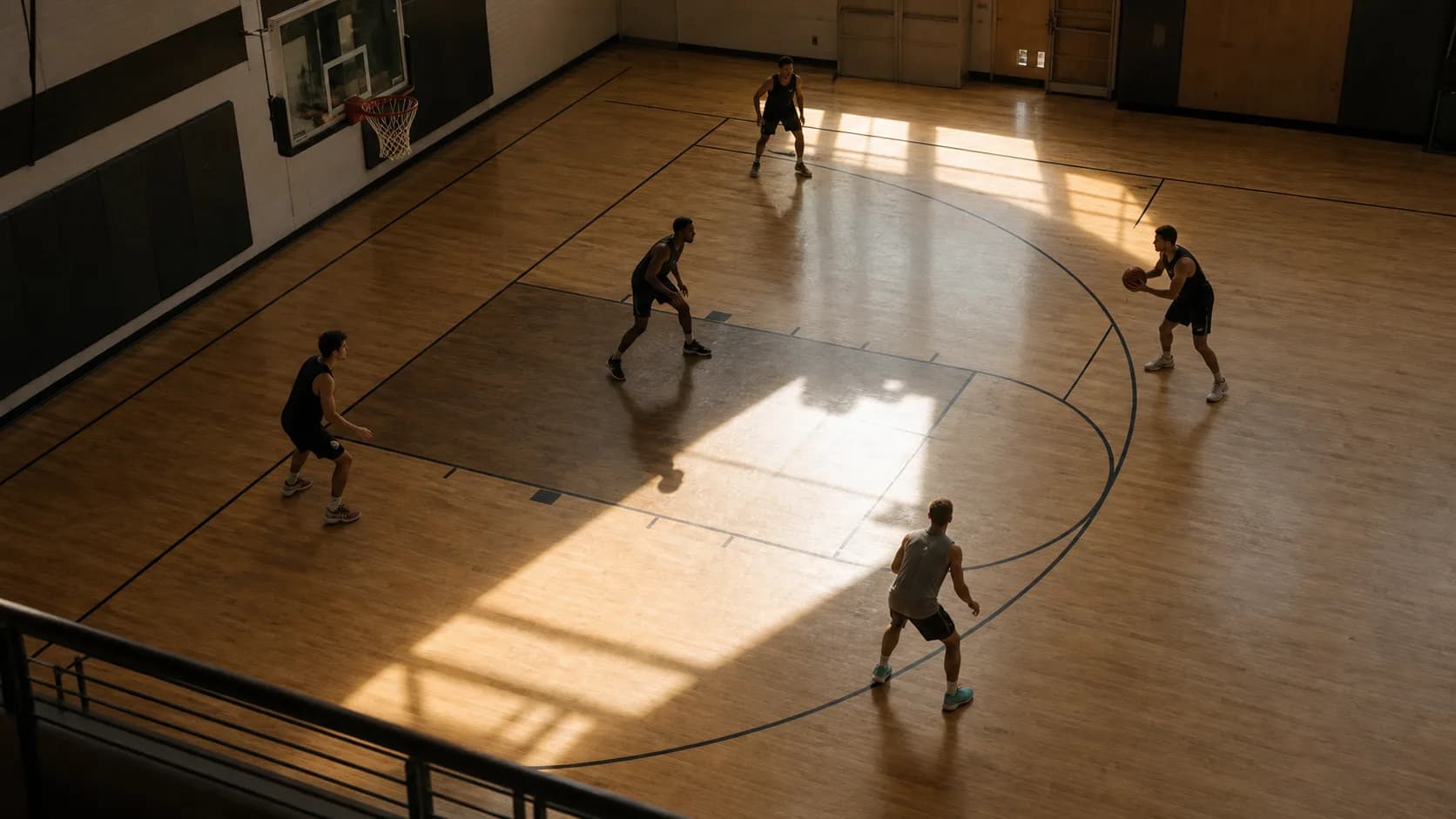
What these drills have in common:
- They rep a decision, not a movement
- Most need only footage and a pause button
- They force a prediction before you see the outcome
- They target the eyes and anticipation, not the hands
- They run in short, dense 20-minute sessions
What is a pause-and-predict drill and how do I do it?
Pause-and-predict is the foundational IQ drill. You watch a possession, pause the frame right before the ball moves, and say out loud what happens next and why. Then you hit play and grade your call. That prediction step is the whole rep.
The reason it works is that it forces you to read cues before the outcome exists. In a live game you never get to see the result first. Pausing early recreates that pressure at your desk, so your brain practices the exact skill the game demands.
Run it on 15 to 20 possessions. Keep a simple tally: right read, wrong read. Do not worry about being right at first. The goal is to build the habit of looking for the tell before the ball tells you. Our full walkthrough of the film study routine sits in the basketball film study guide.
What cues should I be predicting off?
Start with three: the ball handler's eyes, the screen angle, and the help defender's stance. Most actions are telegraphed a beat early by one of these. Training yourself to spot them is what turns watching into reading.
A worked example. On a pick and roll, pause the frame as the screen arrives. Look at the on-ball defender's hips. If they are square and dropping back, the coverage is a drop, and the pull-up or the pocket pass is open. If they jump up to the level of the screen, it is a hedge or a blitz, and the roller or the weak-side skip is coming free. You called the read before the offense ran it.
That level of specificity, hips and top foot and screen angle, is the language HoopBrief speaks in its reports. The product rates behavioral tells by confidence, the quiet edges an advance scout notices. You can train the same eye by naming one cue per clip. Our piece on reading help defenders off the ball drills the weak-side version.
What is a mirror read and why does it matter?
A mirror read is doing pause-and-predict from the defense's point of view. Same clips, but now you predict what the defender should do, not what the offense will do. It builds the other half of your IQ, the anticipation you need on the ball.
Here is how it runs. Pause as the offense starts a play. Instead of asking what the offense does next, ask where you would be if you were guarding the ball, and where the help should rotate. Then watch and compare your positioning to the defender on screen.
Mirror reads matter because defense is where IQ shows up fastest and where most players are blind. Offense gives you the ball and time to think. Defense demands you read and move before the action, every possession. Repping the defensive prediction closes that gap. More on the standing-in-the-right-spot side lives in reading help defenders off ball.
How do I turn film reps into a weekly self-scout?
Take one 20-minute session a week and point pause-and-predict at your own tape. Grade 10 of your own possessions on a single axis: right read or wrong read, ignoring whether the shot fell. The self-scout is where IQ drills become your own improvement, not just general study.
Keep the tally somewhere you will see it. Over four weeks a pattern emerges: maybe you consistently miss the weak-side skip, or you drive into help you should have read. Naming the recurring miss is the payoff. Now you have a specific fix instead of a vague feeling. The 10-possession method in how to study a player in ten possessions works cleanly when the player is you.
Do not skip the honesty part. A self-scout that only finds your good reads is a highlight reel, not a drill. The value is in the misses, because those are the reps you carry back to the gym and the game.
Who should skip these drills, and where do people go wrong?
Be honest with yourself: if you have not locked in the basic fundamentals yet, IQ drills are premature. You cannot execute a great read with a shaky handle or no finishing touch. Build the skills to a working level first, then add the reads. IQ without ability to act on it is just watching.
The most common mistake is turning pause-and-predict into passive watching. The instant you stop making a spoken prediction before each clip, the drill dies. It becomes YouTube. The discomfort of committing to a call and being wrong is the entire training effect, so keep saying the read out loud. Our broader guide to improving basketball IQ covers how to keep the reps honest over months.
The Bottom Line
Basketball IQ drills rep decisions, not moves, and most of them run off the court. Pause-and-predict is the core: stop the clip, call the read from the cues, check yourself. Add mirror reads for defense and a weekly self-scout for your own tape. Twenty minutes, two or three times a week, and you start seeing plays a beat early on the floor.
When you want a scout-grade read on a specific action or a player you are about to face, run it through the HoopBrief Matchup Engine and compare its call to your own.