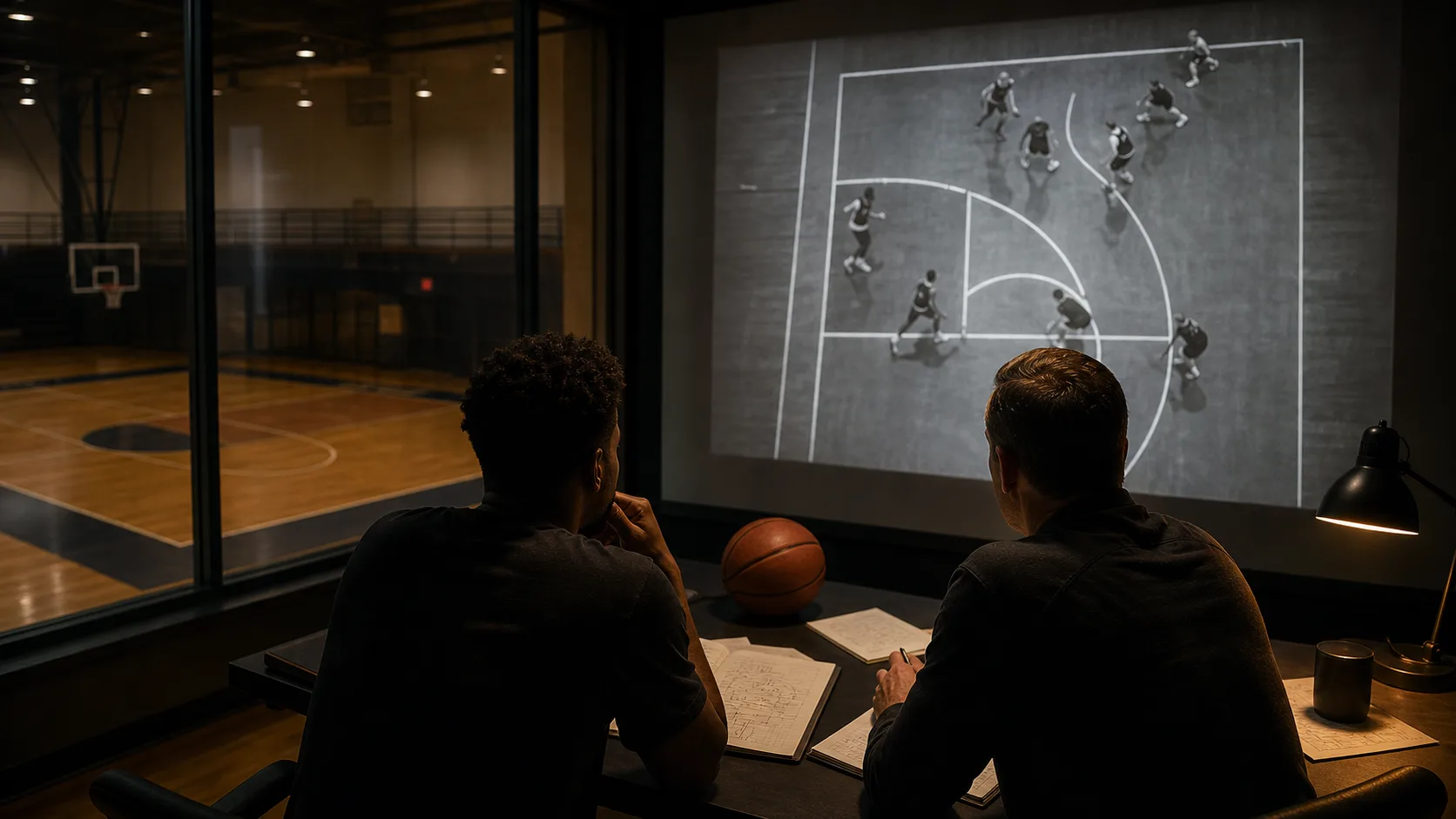
A scouting report says what the opponent does. A game plan says what you will do about it, and it has to fit on one page. The template below has seven boxes: three keys, matchups, ball-screen coverage, their top two actions and your answers, your offense, a transition and rebounding rule, and late-game calls. Fill it in 20 minutes from your scout, put it in front of players in under ten, and put the three keys on the whiteboard. If a line on the page would not change a decision on the floor, cut it.
| Box | What goes in it | Example |
|---|---|---|
| 1. Three keys | Three specific, checkable goals | Keep No. 3 off the line; win the offensive glass; 12 or fewer turnovers |
| 2. Matchups | Who guards whom, and the one rule for each | Jordan on No. 3: chase over screens, no fouls on the drive |
| 3. Ball-screen coverage | One coverage, plus the exception | Drop on the side; switch 1 through 4 late in the clock |
| 4. Their top two actions | What they run most, and your answer | Horns high ball screen: ice it. Corner flare: switch |
| 5. Our offense | What we attack, and three sets | Attack their drop big with pull-ups; sets: 51, Chin, Zoom |
| 6. Transition and glass | One rule each way | Three back on every shot; crash two on theirs |
| 7. Late game | Timeouts, fouls to give, shot-clock plan | Up 3 under 6 seconds: foul. Last shot: start at 8 |
Scouting report or game plan?
Most coaches write a very good scouting report and then hand it to players as if it were the game plan. They are different documents with different readers.
| Scouting report | Game plan | |
|---|---|---|
| Reader | Coaches | Players |
| Question it answers | What do they do? | What will we do? |
| Length | As long as it needs to be | One page |
| Language | Tendencies, numbers, actions | Cues players can repeat |
| When it is done | Before practice planning | Before the walkthrough |
FIBA's coaching manual makes the same point from the other direction: the scout should serve what your team will do, and the tactic should come from what your team has practiced. A game plan is where that translation happens.
Box by box
1. Three keys
Three, not five. FIBA's Level 2 coaching manual advises presenting as little information as possible and picking three or four key things, and giving players a cure rather than a diagnosis. Players remember three things under pressure. Make each one specific enough to check at halftime. "Rebound" is not a key. "Hold them to eight or fewer offensive rebounds" is. The best keys come straight from the numbers that decide games, covered below.
2. Matchups
List who guards whom, and give each assignment exactly one rule. "Jordan on No. 3: chase over screens, no fouls on the drive" is usable. A paragraph of tendencies is not. If you hide a weaker defender, write down where you are hiding him, usually on their worst shooter.
3. Ball-screen coverage
Pick one coverage for the game and one exception. Changing coverages is fine for teams that have practiced it; for most high school teams, one coverage done well beats three done nervously. If you need a refresher, our pick-and-roll coverages guide explains drop, ice, switch and blitz.
4. Their top two actions
Most teams run a handful of actions most of the time. Name their top two and write your answer next to each. Players can prepare for two things. They cannot prepare for twelve.
5. Our offense
Write what you will attack, then the three sets you will lean on. The attack should follow from their weakness: if their big drops, your guards take pull-ups in front of him; if they switch everything, you hunt the smallest defender. Three sets is plenty. The fourth one nobody remembers.
6. Transition and glass
One rule each way. Offensively, decide how many players crash. Defensively, decide how many get back. Write it as a number, because a number is something you can check on film.
7. Late game
Decide in advance: when you foul up three, when you start the last possession, who takes the ball out, and your plan if the shot clock and the game clock are close. In states that added a shot clock this season, this box changed the most, and our shot clock guide walks through the end-of-quarter math.
The four numbers worth putting on the whiteboard
If you want keys that actually predict winning, start with Dean Oliver's Four Factors. Basketball-Reference summarizes his approximate weights like this:
| Factor | How to measure it | Oliver's weight |
|---|---|---|
| Shooting | Effective field goal percentage | About 40% |
| Turnovers | Turnovers per possession | About 25% |
| Rebounding | Offensive rebound percentage | About 20% |
| Free throws | Free throws made relative to shots | About 15% |
Each factor applies to both teams, which gives you eight numbers. Your three keys should usually be the two or three factors where this particular opponent is strongest or weakest. A team that lives at the free-throw line gives you a key. A team that turns it over gives you another.
A filled-in example
Here is how one box looks when it is built from real data. HoopBrief's free How to Guard Anthony Edwards report shows that in 2025-26, 41.8% of his shots were threes (39.6% on 523 attempts), 22.2% came at the rim, where he finished 71.5%, and he got to the free-throw line about 7.2 times a game. Turned into game-plan language, the matchup box becomes:
- Matchup: best perimeter defender, chase over every screen.
- Rule 1: build the wall before he turns the corner; the rim is his best shot.
- Rule 2: no reaching on the drive; the free-throw line is his cheapest offense.
- Help: show early, then rotate to the shooters he feeds most.
Three short lines a player can repeat. That is the whole job. Your opponent will not be Anthony Edwards, but the process is the same: start from where a player scores and how often he gets to the line, then write one rule for each.
Presenting it
Give players the one page, walk through it in five to ten minutes, and end with the three keys. FIBA's manual notes that players lose focus after five to ten minutes of chalk talk, which is a good hard limit. Our guide to presenting a scouting report to players has a full script. At halftime, check the three keys against the box score and adjust one thing, not five.
Common mistakes
- Five or more keys, so none of them stick.
- Generic keys like "play hard" that cannot be checked.
- A new coverage for one opponent that the team has not practiced.
- No late-game box, so the most important decisions get made in a loud huddle.
- A game plan that is really a scouting report, handed to 16-year-olds.
Draft it faster with HoopBrief
AI is good at the first draft of boxes 2 through 5. HoopBrief turns a basketball question such as "how do we guard a scorer who lives at the rim and the free-throw line?" or "how do we attack a team that switches everything?" into a structured, scouting-style answer from public statistical and play-by-play data. It does not know what your team has practiced, who rolled an ankle on Tuesday, or which set your point guard runs best. That is your edit, and it is the part that wins games.
Starter, at $9.99 a month, gives you unlimited questions with attack and guard plans. Pro, at $99 a month, adds all 12 coaching lenses, matchup-specific positioning IQ cues, micro-behavior reports and unlimited saved reports, so every week's plan is there next season. Both bill monthly and cancel in one click. See plans and get started, or run the free scout on your next opponent's best player. For the document that feeds this one, see our scouting report template.