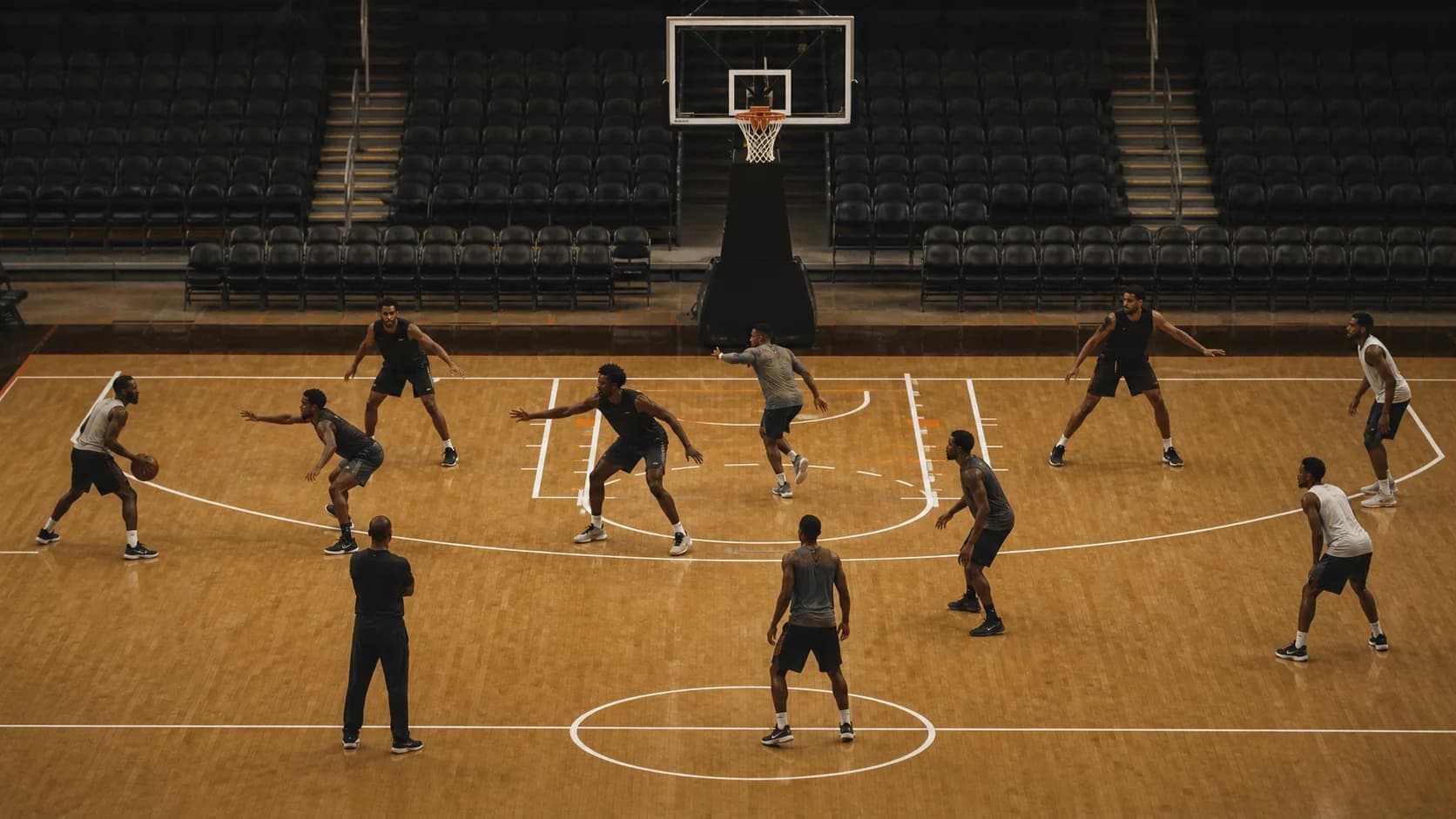
The question "is he a good defender" is asked constantly and answered badly, because the numbers people reach for first are the ones that describe defense worst. Sports Info Solutions found that blocks and steals give results-based information on roughly 2 to 3 percent of a player's defensive possessions, and miss about 80 percent of the possessions where he does something defensively meaningful. Individual defensive rating is worse in a different way: it is so heavily driven by team defensive efficiency that it mostly tells you which team a player is on. So the honest starting point is that the box score cannot answer this question, and most arguments about defenders are arguments about the wrong evidence.
What follows is what does answer it: why each common stat lies, the four questions that actually decide it, what the tracking data adds, and a twenty-minute film method for anyone without tracking data.
Why the box score cannot answer this
| Stat | What it actually measures | How it misleads |
|---|---|---|
| Steals | Possessions ended by his hands | Rewards gambling. A missed steal attempt puts four teammates in rotation and often concedes a transition layup. A bad pass that happens to land in his hands counts the same as a read. |
| Blocks | Shots he got to | Rewards shot-hunting. Leaving the floor on every attempt vacates the defensive glass. Says nothing about the shots he deterred and never had to contest. |
| Defensive rebounds | Rebounds secured | Heavily positional and heavily scheme-driven. Bigs who box out so a guard can collect look worse than the guard. |
| Fouls | Contact the referee called | Cuts both ways. Low fouls can mean discipline or it can mean he never actually contests anything. |
| Defensive rating | The team's defensive efficiency, adjusted a little | Assumes every teammate is equally good at forcing non-steal turnovers and non-block misses. A strong perimeter defender on a weak defense reads as weak. |
| Opponent points per game | How fast the game was | Pace, not defense. A team that plays slowly concedes fewer points while defending no better. |
The pattern across the whole table is the same. Every one of these is a results stat, and defense is mostly a process that ends in someone else's shot. The defender who forces a contested pull-up two with three seconds left on the shot clock has played a nearly perfect possession, and if that shot goes in, every number above blames him for it.
Defensive rating is a team stat wearing a player's name
This one deserves its own section because it is quoted most and understood least.
Basketball-Reference publishes the method openly, and the core assumption is the problem: individual defensive rating leans on the team's defensive efficiency and treats teammates as interchangeable at producing the stops that are not blocks or steals. That produces two systematic errors, in opposite directions, and both are common.
A genuinely good perimeter defender on a bad defensive team will post a bad defensive rating. He is being averaged into four teammates who are conceding. And an ordinary defender on an elite defense will post a good one, because the number he is mostly reporting is his team's.
The practical rule: defensive rating is usable for comparing teammates on the same team in the same season, where the team term is shared and cancels. It is close to meaningless for comparing a player on one team to a player on another. Most arguments that cite it are doing the second thing.
The four questions that actually decide it
Ask these in order. The order matters, because most defenders who get described as bad are failing question two while the argument is stuck on question one.
1. Can he stay in front without help? The baseline. One on one, no screen, does the ball handler get a straight-line drive. This is the question everyone asks, and it is the least discriminating of the four, because at any decent level almost nobody gets beaten clean very often.
2. What happens to the possession when he is screened? This is where defenders are actually made and lost. Does he get through the screen, over it, under it, or does he die on it and force a rotation behind him. A defender who cannot navigate a ball screen breaks the whole defensive shell every time the opponent runs one, which in a modern offense is most possessions. This is the single most predictive of the four and the one no box score touches.
3. Is he where he is supposed to be when the ball is not his? Roughly 80 percent of defensive possessions happen away from the ball. Low man on time, stunt and recover, tag the roller, and back to a shooter. Off-ball discipline is invisible in every stat and obvious on film within a quarter.
4. Who is he actually being asked to guard? The context term that makes or breaks the other three. Guarding the opponent's leading scorer every night produces worse numbers than being hidden on a non-shooter, and every results-based measure will punish the harder job.
What tracking data adds
Modern tracking closes part of the gap, and it is worth knowing what it can and cannot do.
NBA Stats uses Second Spectrum motion tracking to identify the nearest defender on every field goal attempt, which produces opponent field goal percentage as a defender. On its own that is still misleading, because it does not know whether the shot was hard. Paired with an expected field goal percentage model, which estimates how likely a shot was to go in given the situation, the difference between the two is a far better signal: it separates the defender who makes good shooters take bad shots from the defender who is simply never near the ball.
NBA.com's Defensive Pressure Score adds the pressure dimension, and it behaves sensibly, running significantly higher when a defender is on his primary matchup than when he is not. The matchup difficulty family answers question four directly by measuring how much the players a defender is assigned to actually score.
Two honest caveats. Nearest-defender data assigns credit to one person for a result the whole defense produced, so a well-executed scheme flatters the last man standing. And none of this exists below the professional level, which is why the film method below is the one most coaches will actually use.
The twenty-minute film method
This works for a high school or club coach with a game file and no analytics staff.
Pick one opponent game. Do not watch highlights, because highlights are selected on results and results are the thing you are trying to stop trusting. Watch twenty consecutive possessions where your target is on the floor, and log four columns.
| Column | What you write | What it tells you |
|---|---|---|
| Screened? | Yes or no, and over / under / through / died | Question 2, the predictive one |
| Beaten off the dribble? | Yes or no, help needed or not | Question 1, the baseline |
| Off-ball error? | Late, early, or on time on the rotation | Question 3, the invisible one |
| Assignment | Who he was on | Question 4, the context |
Twenty possessions is enough. You are not measuring, you are looking for a pattern, and patterns in defensive habits show up fast. A defender who dies on three of five screens has a fixable technical problem. A defender who is late on four of five rotations has an attention problem, which is a different fix. A defender who does neither and still concedes points is probably guarding somebody very good, and the answer is not to coach him harder but to change the assignment.
That last case is the one that most often gets a player benched unfairly.
Applying it
The evaluation is only worth doing if it changes a decision, and the decision it feeds is the assignment: given what you now know about this defender, who should he actually be guarding on Friday.
That is the two-name question, and it is the one thing a scouting tool can answer in seconds that a spreadsheet cannot. Put the opponent's scorer in as the attacker and your defender in as the defender, and read the breakdown for what the offense wants, how to take it away, and what the counter is when the first option is gone.
Then go do the harder half, which is deciding who takes the assignment in the first place. That is its own problem, and it is covered next.