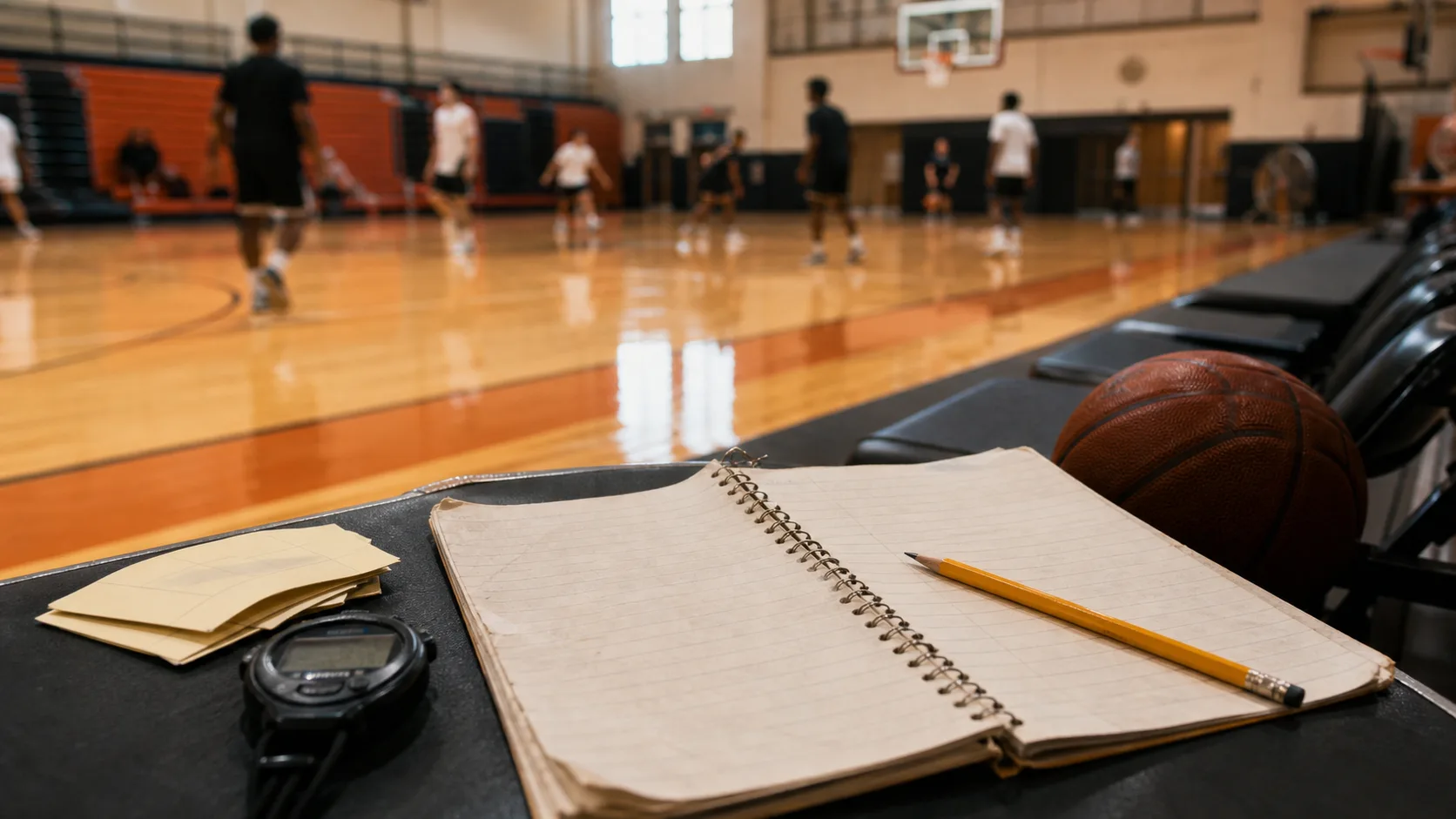
A first-year basketball assistant can make scouting useful by delivering a small, verifiable part of the head coach's game plan: a personnel note, a documented action, a coverage question and a practice cue. Agree on the assignment before building a long report. Your value is in reducing a real staff decision, not producing the largest document.
A new college assistant asking for advice publicly in May 2026 described a familiar concern: understanding basketball as a player did not automatically establish what the staff needed from an assistant. This workflow turns that uncertainty into a defined first scouting deliverable.
Get the brief before watching film
Ask the head coach what decision the scout must support. Personnel matchups, transition priorities, ball-screen coverage and late-clock situations require different evidence. Confirm the deadline, the available recordings and who approves the finished recommendation.
Use this assignment card:
| Field | Agree before starting |
|---|---|
| Opponent and date | Exact team, competition and upcoming game |
| My responsibility | Personnel, actions, special situations or another defined part |
| Evidence available | Current film, statistics, direct observations and known gaps |
| Decision required | The choice the head coach wants help making |
| Delivery | Format, deadline and review meeting |
Ask which terminology the staff already uses. A new label for an existing coverage can create confusion without adding information. If the team has not practiced the proposed response, make that limitation part of the note.
Deliver one evidence chain
For each important observation, keep the chain short enough to verify:
1. Observation: what the opponent repeatedly did in the possessions you reviewed. 2. Context: lineup, spacing, score situation or opponent coverage that affected it. 3. Evidence: clip reference or a correctly scoped statistical sample. 4. Question: which choice this creates for your team. 5. Practice cue: the short action players would need to execute.
For example, “Their handler rejects the screen when the defender arrives high” is an observation to check. “They cannot handle pressure” is a much larger conclusion. State how much you saw and what could contradict the read.
FIBA's advanced coaching manual connects an individual matchup plan with the overall defensive scheme. That is the standard to aim for: the proposed job must fit the other four defenders' jobs. The five-part evidence chain here is an editorial working template, not a quoted FIBA checklist.
Keep personnel notes separate from predictions
A returning player's old statistics can help you form a question. They do not establish the player's current role. Check roster identity, season, minutes and the available new-team evidence before describing a tendency as current.
A first-week sample may be especially incomplete. Use the early-season statistics guide to distinguish a recorded outcome from a reliable tendency. Missing matchup tracking should be described as missing tracking, not proof that two players never met.
Do not hide weak evidence behind a polished PDF or a generated paragraph. An assistant who labels an uncertainty clearly gives the head coach something useful to resolve.
Build a player-facing version
The staff version may contain several alternative explanations. The player version should contain the approved job, a cue and the agreed response. Ask the head coach which details players need and which belong only in the staff discussion.
| Staff question | Player-facing cue after approval |
|---|---|
| Which passing outlet appears against this pressure? | Name the outlet and the movement that makes it visible |
| Who owns the first help rotation? | Name the defender and the triggering event |
| What happens when the first coverage is beaten? | State the practiced recovery rule |
Do not let the table become three universal tactics. Fill it with your team's actual answers. The presentation guide covers the wider meeting; this workflow establishes the assistant's contribution before that meeting exists.
Review what the scout changed
After the game, choose a few possessions relevant to your assignment. Ask whether the predicted action occurred, whether the plan was understood and whether the response was executable. If the opponent changed, record the change rather than defending your original document.
Keep a short staff log: useful observation, unsupported assumption, terminology problem and next improvement. This gives a new assistant a concrete learning loop without claiming that a single game proves the quality of the entire scouting process.
Use software for a bounded task
Try HoopBrief's free NBA scout to evaluate the shape of a structured answer before considering a subscription. It uses public basketball data; it does not ingest your school's private recordings or replace the head coach's approval.
For broader subscriber tools, compare the current plans against the assignment you actually own. A useful product should make that task easier to explain or verify. It should not create a second report nobody on the staff asked for.