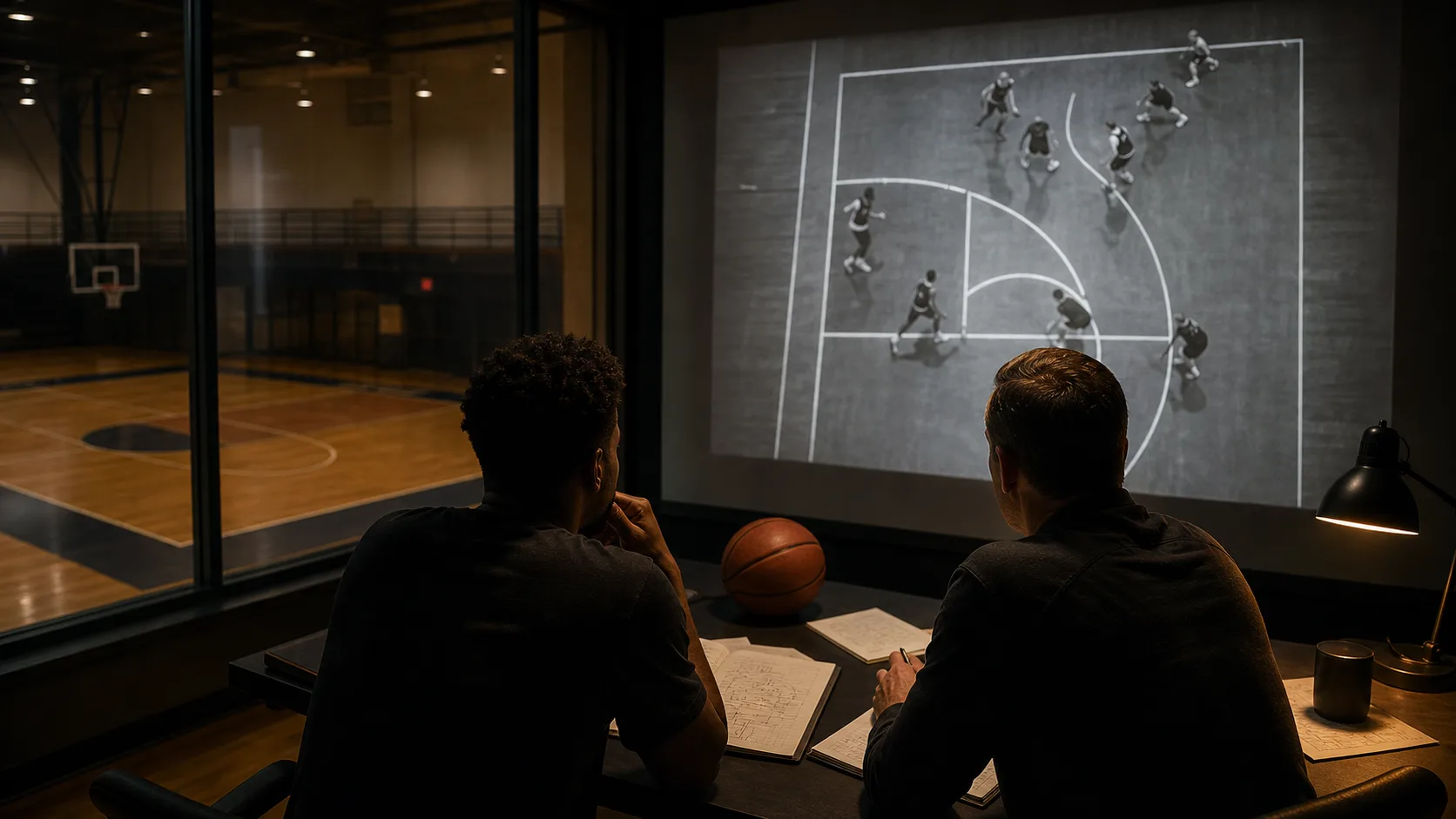
The average college coach makes their full recruiting decision on a player in the first 4 clips of the reel. That's 30-40 seconds of attention before the verdict is essentially set. The remaining 11 clips of a 12-clip reel are confirmation or rejection, not new decision input.
This is the attention math behind recruiting reels, and the math has direct implications for clip order, clip count, and reel length.
The Drop-Off Curve
Based on interviews with college recruiting coordinators, the attention curve looks like this:
- Clips 1-4: 100% of starting coaches watching.
- Clip 5: ~75% still watching.
- Clip 8: ~50% still watching.
- Clip 12: ~30% still watching.
- Clip 15: ~20% still watching.
- Clip 20: ~10% still watching.
The drop-off is steep. Coaches who don't see what they want in the first 4 clips usually don't reach clip 8. Coaches who reach clip 8 usually finish the 12-15 clip reel. Reels over 15 clips lose attention exponentially.
The implication: a 12-clip reel and a 25-clip reel are roughly equivalent in coach attention, most coaches stop at the same point regardless of total clip count. But a 25-clip reel signals amateur judgment ("doesn't know which clips matter"), so it actively hurts.
What This Means for Clip Order
The first 4 clips are the entire decision. They have to cover the entire pitch:
- Clip 1 (the winning play): signals the player affects winning.
- Clip 2 (best translatable skill): signals the player has a real tool.
- Clip 3 (defensive sequence): signals the player plays defense.
- Clip 4 (decision moment): signals the player has basketball IQ.
If your first 4 clips don't span those four categories, the coach is making a decision based on partial information. Reels that open with 4 scoring clips signal "scorer only", which is a narrow ceiling for most college programs. Reels that open with 4 highlight dunks signal "athleticism only", which is a different narrow ceiling.
The opener pitch has to cover the full skill stack in 30 seconds because that's the whole attention budget.
Clips 5-9: The Validation Window
The coach who survives clips 1-4 is now in validation mode. They've made a tentative decision; clips 5-9 either confirm it or change it.
This is where the clip variety matters most. Coaches use clips 5-9 to check whether the early signals hold up:
- Was the winning play (clip 1) a one-time event or a pattern?
- Was the skill (clip 2) repeatable or cherry-picked?
- Was the defense (clip 3) effort-based or system-based?
- Was the decision (clip 4) anticipated or lucky?
The validation window is where 4-5 additional clips covering variety, repetition, and context confirm the early decision.
Want to tag your clip library by category coverage with the same lens college coaches use? Start a HoopBrief plan and the 12-lens framework lets you identify the strongest clips for each category slot.
Clips 10-15: The Diminishing-Return Zone
Coaches who reach clip 10 are mostly already convinced. They watch out of completeness, not decision-making. The clips here either:
- Reinforce the decision (good clips compound).
- Damage the decision (a single bad clip in the late zone can plant a doubt).
The rule: every clip past clip 9 has to be at least as strong as the average of clips 1-9. A weak clip in slot 11 hurts more than a missing clip, because the coach reads "they chose to include this," which signals poor judgment.
This is why 12-15 clips is the sweet spot. 12 lets you maintain quality across every slot; 15 starts to dilute; 20+ actively hurts.
What Long-Game Cuts Are For
A full-game cut (32-40 minutes) is a separate artifact, sent only on request to coaches who survived passes 1-4 and want to see more.
The full-game cut serves a different purpose than the highlight reel:
- The reel proves the *peaks*.
- The full-game cut proves the *consistency*.
A coach interested in the player will request the full-game cut. Sending it unsolicited overwhelms the coach (you've now multiplied their evaluation time by 10x) and signals you don't understand their attention budget.
Keep the full-game cut linked but not embedded in your outreach. Make it easy to request; don't push it at the first contact.
How to Maximize Per-Clip Value
Three rules:
- Pre-tag your full clip library. Watch all your game film and tag every meaningful possession by category, winning play, skill, defense, off-ball, decision, losing-but-right. Most players have 30-50 candidate clips after a season; the tagging lets you pick the strongest 12-15.
- Cut for clarity, not for length. A 6-second clip that shows the full play beats a 4-second cut that compresses it. Don't sacrifice readability for compactness.
- Update quarterly. Fresh clips signal active development. A reel that hasn't changed since November isn't worth re-watching in March.
The Counter-Intuitive Truth
Most young players overweight the reel polish and underweight the reel structure. They spend hours on color grading, music selection, and graphics, and 15 minutes deciding which clips to include.
The right ratio is the opposite. Spend 80% of the editing time on clip selection and order, and 20% on production polish. The clips are the pitch; the production is just the wrapper.
A boring-looking reel with the right clips beats a beautiful-looking reel with the wrong clips in every coaching room we've checked.
HoopBrief currently turns basketball and matchup questions into structured reports using public statistical and play-by-play context. It does not accept film uploads or provide possession-level video tagging.
Where to Go Next
Companion recruiting pieces: how to build a recruiting film that stands out, what makes a recruit stand out in film, how college coaches evaluate recruits on film.
Next step, send the reel: how to make a strong first impression in recruiting.
Hub: Recruiting Hub.