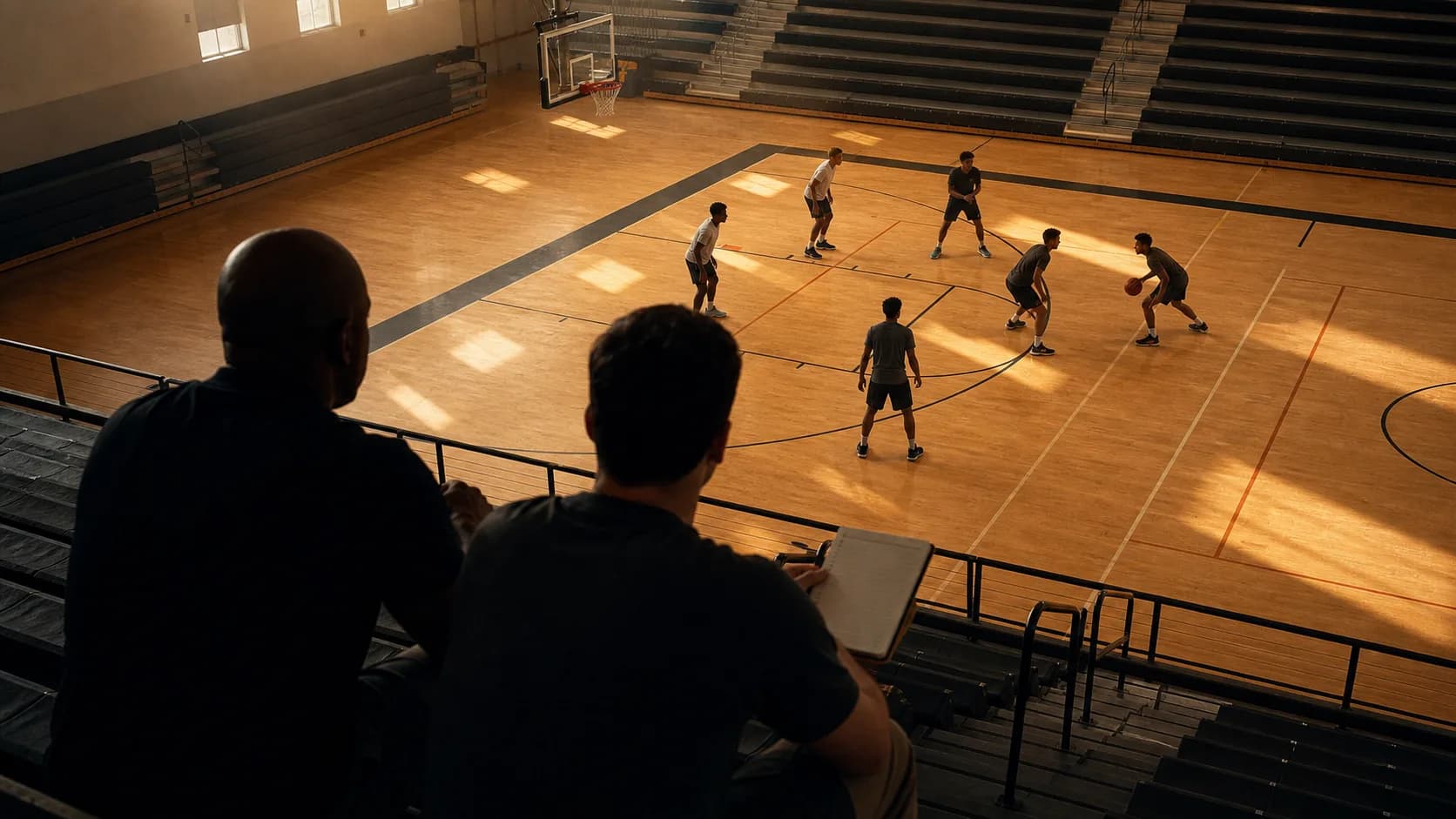
A college coach who's seriously interested in your tape will watch it six different ways. Each way is a separate pass with a separate purpose. Each pass either filters you out or escalates you to the next pass. By the sixth pass, the coach has invested 4-6 hours in evaluating you, but only top-priority recruits ever get there. Most reels get filtered out in pass 1.
This piece is the six-pass workflow, what each pass reveals, and what your film needs to survive each one.
Pass 1: The 38-Second Skim
Purpose: filter out reels that aren't worth the 4-minute watch.
The coach opens the reel, watches roughly 4 clips (38 seconds at ~10 seconds each), and decides whether to keep going.
What kills a reel here:
- The opening clip is a meaningless three against a defender 4 inches shorter and obviously a step slow.
- The production has amateur signals: loud music, on-screen text predicting plays, cuts under 4 seconds.
- The first 4 clips are all the same type, usually all scoring, no defense.
What survives this pass:
- Opening clip is a winning play (a late-game stop, a key assist, a contested rebound that mattered).
- Production is clean: short title card, audio at a reasonable level, no excessive graphics.
- The first 4 clips span at least 3 categories (winning play, skill, defense, decision).
Roughly 70-80% of reels are filtered out in pass 1.
Pass 2: The 4-Minute Reel Watch
Purpose: evaluate the full skill stack and the clip variety.
The coach watches all 12-15 clips at normal speed. Notes:
- Variety of clip types (offense, defense, off-ball, decision, losing-but-right).
- Visual quality (camera angle, lighting, opponent quality).
- Pace and rhythm of the reel (does it flow or feel like a list?).
What kills a reel here:
- The reel reveals the player has one good skill and 11 average clips supporting it.
- Defensive clips are tagged on at the end as an afterthought (signal: player added them because they "should" be there, not because defense is real).
- Competition level is obviously weak across all clips.
What survives:
- The skill stack is genuinely broad, clips show 3-4 translatable tools.
- Defensive clips look like organic basketball, not coached posing.
- At least 6-8 clips come from credible competition (state-level games, EYBL/3SSB/UAA, top-tier prep).
About 30% of pass-1 survivors make it through pass 2.
Pass 3: The Decision Moment Review
Purpose: evaluate cognitive workflow on specific possessions.
The coach picks 3-5 possessions from the reel and watches each one twice, once at normal speed, once paused at the moment the defense reveals coverage. The pause is the test: did the player make the correct next read?
What kills a reel here:
- The player consistently takes the obvious read (the highlight) but misses the correct read (the better outcome).
- Decision speed looks slow, 0.7-1.0 second processing where 0.4-0.5 is needed for the next level.
- Recovery after a mistake is poor, body language deteriorates after a missed read.
What survives:
- The player makes correct reads on 70%+ of paused possessions.
- Decision speed looks at-level or above-level for the recruiting tier.
- Mistake recovery is professional, no sulking, no arguing, immediate focus on the next play.
About 25-35% of pass-2 survivors make it through pass 3.
HoopBrief currently turns basketball and matchup questions into structured reports using public statistical and play-by-play context. It does not accept film uploads or provide possession-level video tagging.
Pass 4: The Defensive Ground Covered Tally
Purpose: quantify defensive impact.
The coach watches the defensive clips specifically and counts how much ground the player covers on each possession. The benchmark: 15+ feet of ground-covering action per defensive possession on the clips selected.
What kills a reel here:
- The defensive clips show the player guarding the ball but never helping, recovering, or rotating.
- The ground-covered count is under 10 feet per possession (signal: stand-and-watch defender).
- The intensity drops off in the second half of clips (signal: motor issues).
What survives:
- Ground-covered count is 15-25+ feet per possession.
- Help rotations and recoveries are visible and timely.
- Intensity is consistent across the defensive clip set.
About 50-60% of pass-3 survivors make it through pass 4 (the defensive bar is lower than the offensive bar at the recruiting filter level).
Pass 5: The Full-Game Cut Request
Purpose: see how the player performs across an unedited 32-40 minutes.
The coach emails the player (or their HS/AAU coach) requesting a full-game cut from a recent quality opponent. They watch the full game, usually at 1.5x speed, and evaluate:
- Possession-by-possession consistency (does the highlight-reel skill show up across the full game or just in the cut?).
- Performance against credible competition.
- Motor across the full 32-40 minutes.
- Trust signal from the coach (does the player play in the last 4 minutes of close games?).
What kills a reel here:
- The full-game cut reveals the highlight reel was cherry-picked from a 4-of-15 shooting night.
- Motor visibly drops in the third quarter or in the second game of a tournament.
- The player isn't on the floor in winning time.
What survives:
- Per-possession efficiency in the full game matches or exceeds the highlight average.
- Motor holds across the full 32-40 minutes.
- Trust signal is positive (player in late-game lineups).
About 40-50% of pass-4 survivors make it through pass 5.
Pass 6: Live-Event Verification
Purpose: confirm the film translates to live evaluation.
The coach attends a live event (AAU weekend, high school showcase, summer camp) specifically to watch the recruit in person. They evaluate:
- Whether the live-speed game matches the film-speed game.
- Body language, locker-room presence, and coachability in real time.
- Interactions with teammates and officials.
- Physical projection (frame, length, athletic tools confirmed in person).
What kills the recruit here:
- The live game looks slower than the film (signal: film was edited to highlight a slower player).
- Body language is unprofessional.
- Physical tools were over-stated on the recruiting profile.
What survives:
- Live game matches or exceeds film.
- Professional behavior throughout the event.
- Physical tools verified.
A recruit who survives pass 6 receives a scholarship offer or a formal recruiting commitment.
The Total Time Investment
A coach who runs the full 6-pass workflow on a recruit has invested:
- Pass 1: 38 seconds.
- Pass 2: 4 minutes.
- Pass 3: 15-20 minutes.
- Pass 4: 8-12 minutes.
- Pass 5: 45-60 minutes (full-game cut at 1.5x).
- Pass 6: 4-6 hours (travel + live attendance).
Total: 5-7 hours per recruit. This is why only top-priority recruits make it to pass 6. Most are filtered out at pass 1 or 2.
How to Build a Reel That Survives All 6 Passes
Each pass tests different elements. The reel that survives all six:
- Opens with a winning play (survives pass 1).
- Mixes clip types across offense, defense, off-ball, decision, losing-but-right (survives pass 2).
- Includes 3-5 decision moments where the correct read is visible (survives pass 3).
- Shows defensive ground covered on 4-5 dedicated defensive clips (survives pass 4).
- Has full-game cuts available on request (sets up pass 5).
- Matches the player's actual live game (sets up pass 6).
Our how to build a recruiting film that stands out piece covers the editing-side details. Our what makes a recruit stand out in film piece covers the clip-mix detail.
HoopBrief currently turns basketball and matchup questions into structured reports using public statistical and play-by-play context. It does not accept film uploads or provide possession-level video tagging.
Where to Go Next
Companion recruiting pieces: how to build a recruiting film that stands out, what makes a recruit stand out in film, how many film clips coaches actually watch.
Next step, send the film: how to make a strong first impression in recruiting.
Hub: Recruiting Hub.