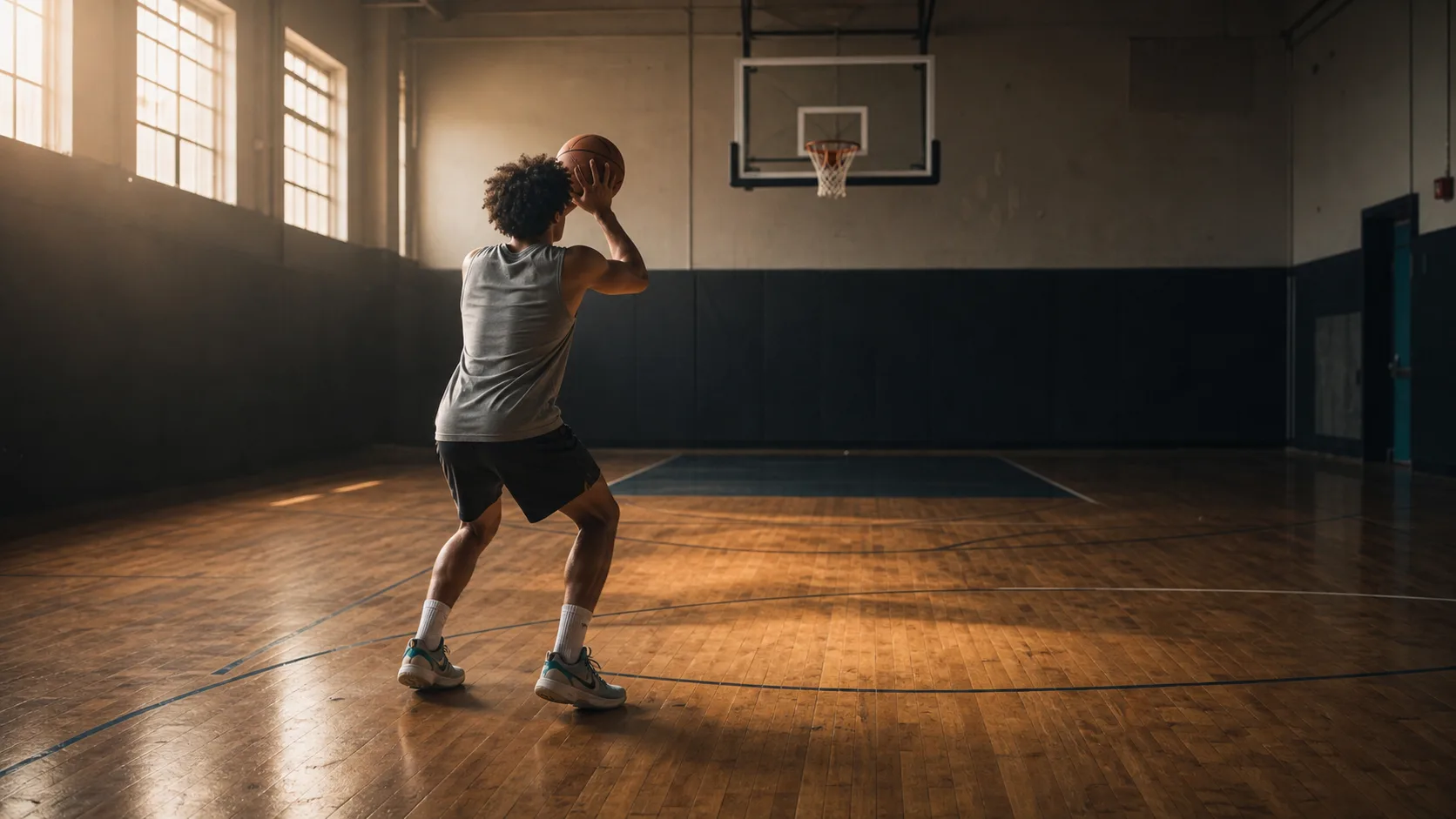
A rebound is two skills stacked on top of each other. The first is box-out: physically preventing your opponent from getting position. The second is the read: knowing where the ball is going before it gets there. Most coaches teach the first and ignore the second. The result is players who box out beautifully and grab nothing.
The Box-Out: Three Points of Contact
A real box-out has three contact points: chest-to-chest at the start, hip-to-hip in the middle, and back-to-front at the finish. Each one is a step in a sequence.
The chest-to-chest is the engagement. As soon as the shot goes up, you find your man and put your chest on his. Don't reach for the rebound yet. Don't even look. Just engage.
The hip-to-hip is the pivot. You turn 180 degrees on your inside foot, sliding your hip across his hip. Now your back is to his front. He's behind you. He has to go around or through, and both options are slow.
The back-to-front is the finish. With your back on his front, you walk him backwards a half-step at a time, creating space. By the time the ball comes off the rim, you have an arm's length of clear airspace above your head. He's still behind you. The rebound is yours.
The Most-Common Box-Out Mistake
Watching the ball. Players see the shot, watch its arc, and forget about the man they're supposed to box out. By the time the shot hits the rim, their opponent has already gotten inside position, and there's no rebound to grab.
The rule: never watch the shot. Watch your man. Engage chest-to-chest. Pivot. Then, and only then, find the ball. Most rebounds are won in the first 0.8 seconds after the shot, before anyone is looking up.
The Read: Where Does the Ball Actually Go?
Long shots produce long rebounds. Short shots produce long rebounds the other way. Side shots produce side rebounds. None of this is intuitive, it's a skill you build with film.
The general rule: a missed shot bounces back at the same angle it came in at. A three-pointer from the wing typically misses long, with the rebound landing 4–6 feet from the rim on the opposite side. A short jumper from the elbow typically misses short, with the rebound landing 1–2 feet from the rim on the same side.
The best rebounders don't camp under the rim. They camp where the ball is going.
The Second-Jump Rebound
Half of NBA offensive rebounds are second-jump rebounds. The first jump is a tip. The ball stays in the air or pops to a teammate. The second jump, the one most defenders don't make, is what actually wins the possession.
To second-jump, you have to land balanced. If you windmill on the first jump and lose your footing, you can't get back up. The cure is technique: jump straight up, land straight down, knees ready. As soon as you land, you're loaded for the next jump.
The best offensive rebounders in the league are second-jumpers, not first-jumpers. They land, see the tip, and explode again. The defender, who jumped once and landed badly, is still trying to find his feet.
Tipping vs. Grabbing
If you can grab a rebound clean, grab it. If you can't, tip it. A clean tip to a teammate is worth more than a contested grab that turns into a turnover.
The cue: if you can get two hands on the ball, grab. If you can only get one hand, tip. The angle of the tip matters, tip toward your team's basket, never out of bounds. Even a tip that goes to a defender at half-court is better than the alternative of letting the rebound die in the lane.
Long Misses and the Outlet
When a shot misses long, the rebound often goes to the perimeter. That's the outlet rebound, the one your guards should be ready for. A missed three from the corner can travel 20 feet in the air before it lands at the top of the key. A guard standing at the elbow has 8 feet to read the angle and start moving. The good ones see it coming and turn the rebound into a fast break.
The Discipline of Defensive Boxing Out
The team that wants the rebound less, gets fewer rebounds. Most defensive teams have one or two players who box out and three who watch. That's how 28% of NBA offensive rebounds happen, somebody on defense forgot to do their job.
Every defender has to box out. The rule: as soon as the shot goes up, find your man and engage. Even if the rebound goes to a teammate, you've just kept your man from getting a putback. That's the play.
Drill: 5-on-5 Box-Out, No Hands
Run a half-court possession. Coach calls "shot!" at any moment. Both teams have to box out, but neither team can grab the rebound. They just have to hold their box for three full seconds. The drill teaches commitment to the box without the reward of the grab.
Done daily, it builds the habit that wins playoff games: every player engaged on every shot, every time.
The Quiet Edge
Watch a great defensive rebounder, Bam Adebayo, Jarrett Allen, Domantas Sabonis. Notice that they're not always the highest jumpers. They're the ones who engaged first, pivoted hardest, and were still standing when the ball came off the rim. The rebound is a relay: chest, then hip, then back, then ball. Skip a step and the chain breaks.
Rebounding is decided before the ball comes off the rim. Win the box, and the read takes care of itself.
Keep reading: transition defense principles, basketball conditioning, and defensive positioning.