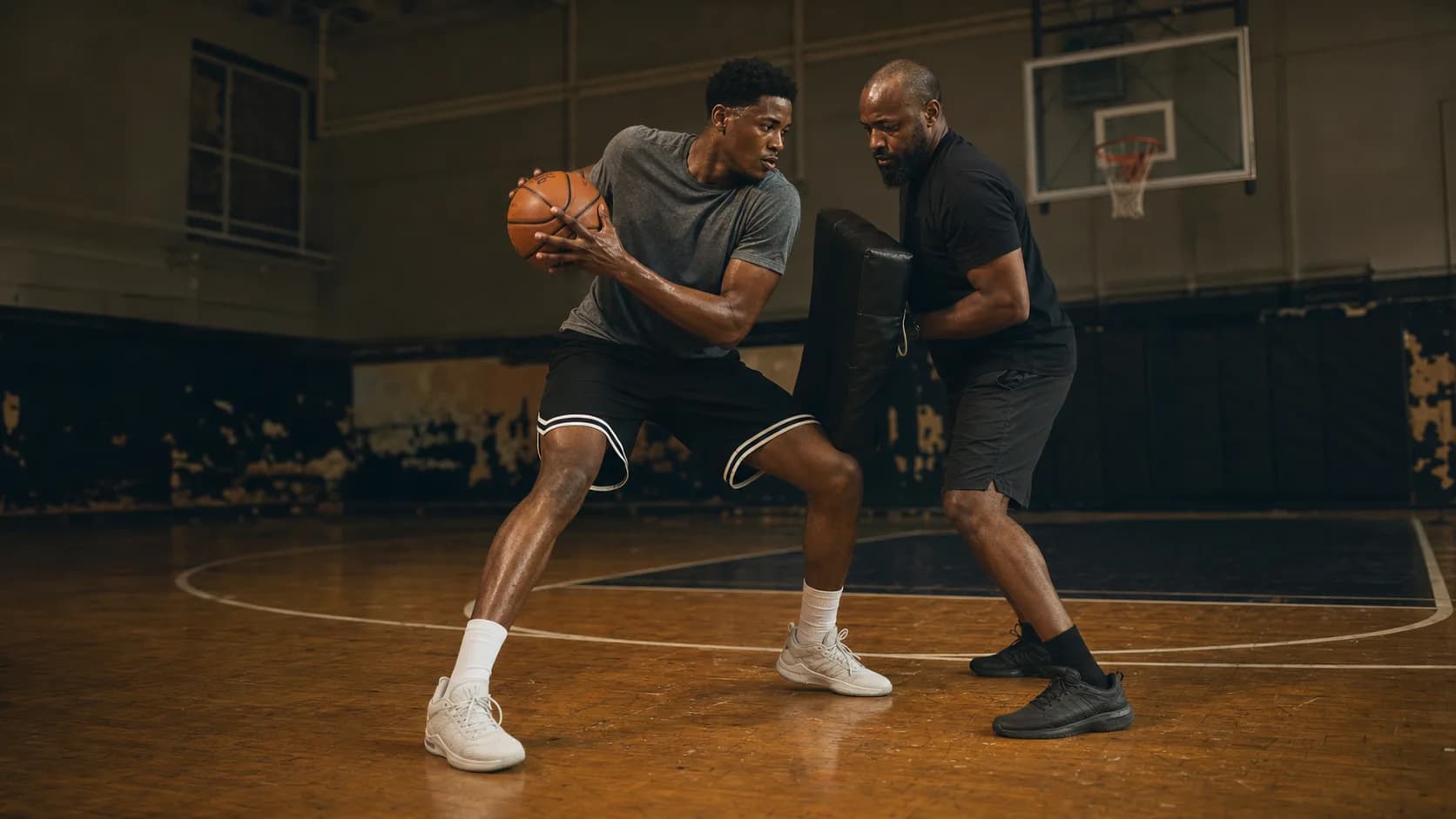
The short answer: The jab step, pivot, and jump stop are basketball's three foundational footwork patterns. Most players never master them, which is why they get stripped on rip-throughs, called for travels on pivots, and lose balance on jump stops. Each pattern has a specific cue and a specific drill. Five minutes of daily work builds them all.
Footwork is the most-coached skill nobody actually teaches. Coaches yell "good footwork!" without explaining what good footwork is. Players nod and keep doing what they were doing.
This article is the missing manual. Three patterns, three sets of cues, three drills. Master these and you've solved 60% of the technical problems most players have.
Jab Step: Foot, Knee, Weight, Eye
The jab step is a fake, your strong-side foot extends 6-12 inches toward the defender, then you decide whether to drive that direction or pull it back and shoot.
The cues:
Foot: plant on the ball of the foot, not the heel. A heel-down jab is slow and reads as a real drive only if the defender is unpracticed. Ball-of-foot jabs are explosive and reset quickly.
Knee: the front knee bends slightly during the jab, about 20 degrees. A locked-knee jab doesn't sell the fake. A 90-degree-bent knee is too committed and slow to retract.
Weight: your weight stays on your back foot during the jab. This is the most-missed cue. Most amateur players shift their weight forward into the jab, which means they can't pull it back fast. Elite players keep 70% of their weight back even while the front foot is extended.
Eye: look at the defender's chest, not their feet. Your eye line tells the defender what you're going to do. Looking down telegraphs.
Done correctly, a jab step makes the defender shift weight to one side, and you drive the other side. Done incorrectly, the defender doesn't react and you've wasted a half-second.
The Pivot: Front vs Reverse
A pivot is rotating around one stationary foot. Two kinds:
Front pivot: the moving foot goes forward and around. Used when you've caught the ball with your back to the defense and need to face up.
Reverse pivot: the moving foot goes backward and around. Used when you're protecting the ball or creating space.
The cues:
Plant the pivot foot. Once you pick it up, you've traveled. Most travels happen because players don't know which foot is their pivot. The rule: the foot that hits the ground first when you catch the ball is your pivot foot. Track it.
Rotate on the ball of the pivot foot. Heel-rotation is slower and gets called for travels because the heel often slides. Ball-of-foot rotation is clean.
Keep the ball below your shoulders during the pivot. A high ball during a pivot is a stripped ball. Pull the ball into your chest with elbows out. Defenders bouncing off your elbows is legal and creates space.
The single most-common pivot mistake: ripping the ball through. Rip-throughs require both feet to be planted; if you rip while pivoting, you'll travel. Rip THEN pivot, or pivot THEN rip, never both at once.
The Jump Stop: Timing and Balance
A jump stop is landing on both feet simultaneously after a dribble or catch. It gives you the ability to use either foot as a pivot, which is a tactical advantage.
The cues:
Both feet hit at the same time. Not within 0.1 seconds. Same time. A staggered landing means the first foot is your pivot, and you've lost the option.
Land in a low athletic stance. Knees bent ~30 degrees, weight even, ball under control. A jump stop that lands tall is the worst kind, you can't drive, can't pivot quickly, can't shoot quickly.
Land balanced before you do anything. Most jump-stop fails are because the player lands and immediately tries to do something, and the lack of balance produces a turnover or a bad shot. Land first, decide second. Even if it's only 0.2 seconds, that pause is the difference.
The jump stop is most useful at the end of a drive. You take 2-3 dribbles toward the rim, jump-stop in the lane, and now have all three options (drive either way, pull-up, kick) without the defender knowing which one you'll pick.
Why Footwork Beats Handle at Every Level
Watch any AAU game. The flashiest ball-handlers get stripped 5 times a game. Watch any NBA game. The best players have basic handles but elite footwork.
The reason: footwork is the foundation under everything. A player with elite footwork and average handle gets to their spots. A player with elite handle and bad footwork gets stripped at their spots.
If you have to choose between a hour of handle work and an hour of footwork, choose footwork every time. The handle is finish work. The footwork is the frame.
The 5-Minute Daily Footwork Routine
Run this every day before practice:
Minute 1: 30 seconds of jab steps in a stance. Focus on weight staying back.
Minute 2: 30 seconds of front pivots, alternating feet. 30 seconds of reverse pivots.
Minute 3: 20 jump stops from a sprint. Land balanced. Pause 0.2 seconds. Pivot. Repeat.
Minute 4: 10 jab-then-drive reps each direction. 10 jab-then-shoot reps each direction.
Minute 5: 10 catch-and-pivot reps. Catch with back to basket, front-pivot to face up, jab, drive.
Five minutes. Daily. For three months. By the end, your footwork is automatic, better than 90% of players at your level.
Frequently Asked
Do referees actually call traveling consistently? No. The call is inconsistent. But better footwork eliminates the calls referees DO make, and you get the benefit of doubt on borderline ones.
Should I work on footwork off the bounce or stationary first? Stationary first. Get the patterns right without the dribble. Add the dribble after the patterns are clean.
How do I know my pivot foot? It's the foot that hit the ground FIRST when you caught or stopped. If both hit simultaneously (jump stop), either foot works.
The Quiet Edge
The next time you watch a great player score, slow it down. Notice their feet. They are always, always, in the right position. The handle is a finish. The footwork is the foundation.
The player with great footwork and a basic handle will have a longer career than the player with a flashy handle and bad footwork. Every time.
Keep reading: finishing at the rim, off-ball cuts, and guard drills.