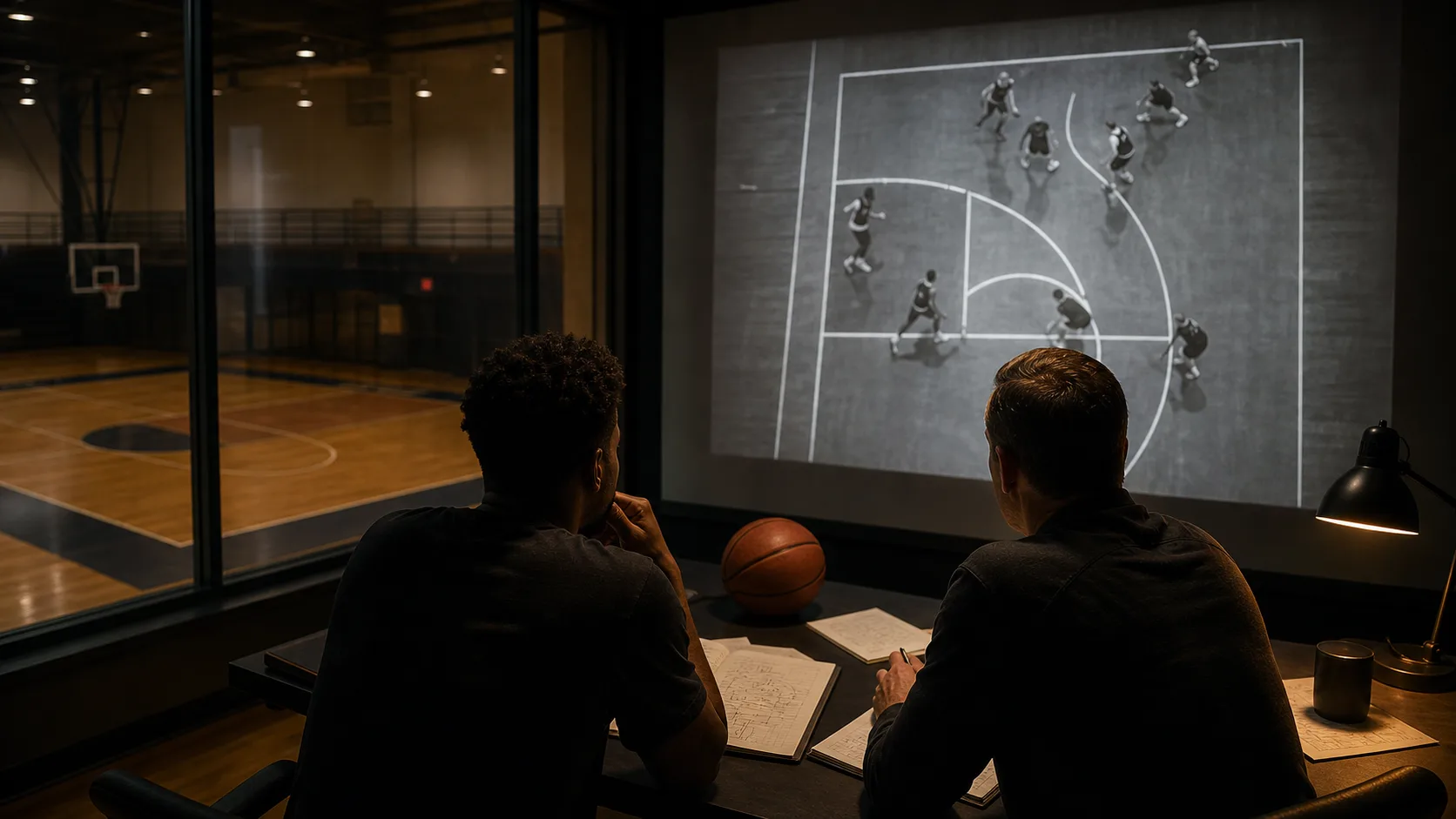
Twenty-eight years. Five championships. Eleven different head coaches and counting have launched out of Gregg Popovich's staff. What makes this coaching tree different from every other in NBA history isn't the win total, Phil Jackson's tree won more rings. It's that the *system* survives the people who carry it.
This is the institutional-history piece. For the foundational philosophy itself, read Popovich's system thinking, explained. For how the system merged with Mike D'Antoni's pace-and-space to become modern NBA offense, read the Popovich and D'Antoni synthesis.
A Popovich-trained head coach in 2026 still teaches role clarity, still values defensive principle over scheme complexity, still demands ball movement that produces 0.5-second decisions, and still treats player development as the actual job. The names change. The system doesn't.
What "System Thinking" Actually Means in San Antonio
Three pillars define the Spurs system, and every branch of the tree inherits at least two:
Pillar 1, Role clarity over star deference. A starter knows what he's responsible for. A bench player knows what he's responsible for. Both lists are short, specific, and graded on tape. Stars don't get exceptions; they get more responsibilities. This is the cultural pillar, and it's what most other staffs can't copy.
Pillar 2, Principle-based offense. The Spurs almost never beat you with a set play. They beat you with the third action, a swing pass, a re-screen, a back cut, that came after the set play was defended. Players are trained to *read*, not *recall*. The opening action is a starting point.
Pillar 3, Player development as the primary product. Every Popovich staff has spent more practice minutes on individual development than on opponent prep. The bet: a rotation of player-developed pros beats a rotation of star-deferred athletes over an 82-game season. It's a bet that paid off five times.
When you watch a Pop-tree head coach today, look for these three. Two of three is the baseline. Three of three is a Spurs-DNA staff.
The First Generation (2000s, Early 2010s)
The first wave was R.C. Buford's hire list crossed with Pop's discipline.
[Mike Budenholzer](https://www.si.com/nba/gregg-popovich-coaching-tree-every-nba-head-coach-that-worked-spurs-staff) (Hawks, Bucks, Suns): the cleanest carrier of the system. Spent 19 seasons with the Spurs (1994-2013), starting as a video coordinator before climbing to associate head coach. Ran Spurs offense in Atlanta with Schroder and Millsap; won a title in Milwaukee with Giannis using the same role-clarity model. Bud's branches are now in Phoenix and beyond.
Mike Brown (Cavs, Lakers, Kings, Warriors-asst): defensive principle over personnel. The 2005-2010 Cavs ran Spurs-style defensive rotations with LeBron at the top. Brown's emphasis on defensive switchability shaped the modern era as much as Pop's offense did.
Brett Brown (76ers, Spurs-asst): inherited the development pillar more than the offense. Process-era Philly was a system-thinking project applied to a tank.
Avery Johnson (Mavs, Nets): the first Pop assistant to win a head coaching job. Carried Pop's defensive principles into Dallas's 2005-06 Finals run.
Rick Carlisle (briefly with Pop, then independent): less a direct tree branch than a peer who absorbed and adapted.
Ettore Messina (Spurs-asst, Italian + Russian national teams): exported the system internationally. EuroLeague and FIBA system basketball owes a real debt to Messina.
The Second Generation (Late 2010s, 2020s)
Pop's later staffs were deliberately younger and more diverse. The result: a coaching tree that looks nothing like its first generation.
[Becky Hammon](https://www.si.com/nba/gregg-popovich-coaching-tree-every-nba-head-coach-that-worked-spurs-staff) (WNBA Aces, Spurs-asst): hired in August 2014 as the NBA's first full-time, paid female assistant coach. Back-to-back WNBA titles with the Aces in 2022 and 2023. Hammon's Aces ran Spurs offense, read-and-react, ball movement, role clarity, with a heavier dose of switchability. The system traveled across leagues.
Will Hardy (Jazz, Celtics-asst, Spurs-asst): the cleanest second-generation carrier. Hardy's Utah Jazz teach the same principle-based offense, with a modern shooting emphasis.
James Borrego (Hornets, Pelicans-asst, Spurs-asst): pace-up adaptation. Borrego ran Spurs principles at a higher tempo and with more transition emphasis.
Ime Udoka (Celtics, Rockets, Spurs-asst): defensive principle plus modernized switch coverage. Udoka's Boston run (2021-22 Finals) showed what Spurs DNA looks like with elite wing personnel.
Taylor Jenkins (Grizzlies, Spurs-asst, Bucks-asst, through Bud): inherited the development pillar most explicitly. Memphis under Jenkins built one of the league's deepest development pipelines.
What Has Survived and What Has Adapted
The system survived in two ways and changed in three.
Survived: role clarity (every branch teaches it) and player development (every staff prioritizes it). These are the cultural pillars; they don't depend on era or roster.
Adapted: the offense (most branches now run more pick-and-roll and more shooting than Pop's prime Spurs); the pace (almost every modern branch plays faster); and the *vocabulary* (the Spurs called actions by name; modern branches teach concepts by principle).
The thing every branch still does, and that no other coaching tree replicates: they design rotations around the player who's been in the system longest, not the player who scored the most last night. Continuity is the system's hidden pillar.
Why the Tree Will Keep Growing
Two structural reasons:
1. Pop deliberately pushed assistants out. Most coaching trees grow slowly because head coaches keep their best assistants. Pop's staffs turned over every 3-5 years by design. Assistants left with head-coach readiness baked in. 2. The system transfers cleanly. Because it's principle-based, not playbook-based, a new staff can install it in 18-24 months. Schemes don't transfer; principles do.
The third generation is already running. The fourth will be drawn from the second-generation staffs' assistants, Hardy's bench, Hammon's bench, Udoka's bench. The tree is now 28 years old and accelerating.
Reading the Tree in HoopBrief
The Lens System pillar is, in part, an attempt to formalize what Popovich-tree staffs do intuitively: watch the same possession through multiple perspectives, default to the lens that matches your role, and switch lenses when the situation demands it. The System lens specifically is built around Spurs-DNA thinking, role clarity, principle-based reads, development weight.
The original Popovich system-thinking breakdown covers the principles in depth. This piece traces where those principles are running today.
The tree isn't a metaphor. It's a real institutional structure that's reshaping how the league coaches. The next decade of NBA head coaches is mostly going to come from it.
More From the Playoff Prep Hub
The Pop-tree staffs win playoffs because the system survives scouted adjustments. For the broader playoff-prep framework: how NBA coaches prepare for playoffs, what coaches look for in matchup prep, conference finals adjustments by Game 3, playoff adjustments, what changes in 7 games.
Hub: Playoff Prep Hub.