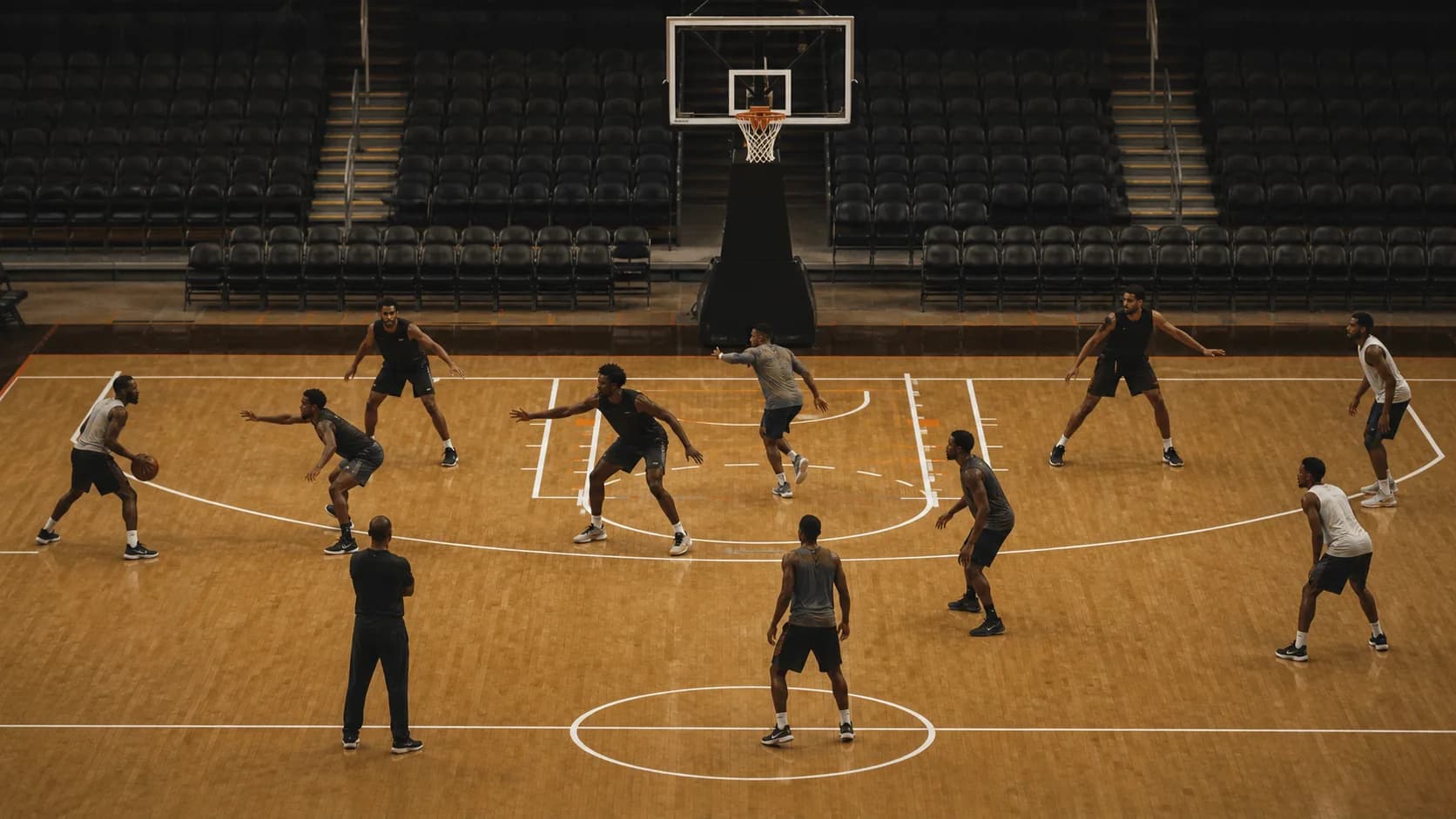
By the time the 2026 NBA Finals tip off, both staffs already know what they're going to do. They've watched 14-21 games of opponent tape, run lineup-level matchup grades, committed to rotations, and locked the scouting doctrine. The series doesn't reward better preparation, both staffs are prepared. The series rewards which staff executes their brief better, faster, and longer than the other.
Here's the brief, in three lenses. Read it before Game 1. Re-read it after Game 3. The brief is the same; what changes is which lens is doing the heaviest work.
Lens 1: The Matchup Math
The most important number in any Finals series is expected points-per-100 differential per lineup state. Both staffs have run the math; the question is which staff acts on it.
Three lineup states decide every Finals:
Starters vs Starters. Both teams' top 5 on the floor. Usually the first 6-8 minutes of each quarter. This is where the series identity lives, if one team has a structural edge here, it shows up in 30+ minutes of total floor time across a 7-game series.
Bench-Heavy Stretches. When at least 3 reserves are on the floor for both teams. Usually the 6-9 minute mark of each quarter, plus the late-1st / late-3rd transitions. Bench-heavy stretches are where series get won by depth, and where the rotation-tightening from Conference Finals starts paying off (see the three Conference Finals adjustments every staff makes by Game 3).
Closing Lineups. The 4 minutes that decide every close game. The crunch unit, both ways. This is where the matchup math meets the personnel: who can credibly check whom, and who has the credible iso to attack on the other end.
The way to read the matchup math in real time: track which team is +/- in which lineup state across the first three games. By Game 4, the team that's +5 or better in two of three lineup states is in commanding position; the team that's +5 in just one is in trouble.
Lens 2: The Tactical Commitments
By the time the Finals start, every staff has committed to a tactical doctrine they refined through the Conference Finals. The doctrine is usually three commitments deep:
Commitment 1: The Coverage Identity. Will the defense default to drop, switch, or ICE on pick-and-roll? Whatever the staff committed to in CF, they're locked in for the first 2-3 games of the Finals. Adjusting mid-series happens, but only after the original coverage is broken. The pick-and-roll counter library is the playbook for what the offense will run against whatever coverage the defense has committed to.
Commitment 2: The ATO Package. Every staff arrives at the Finals with 8-12 after-timeout sets ready to run. Half are familiar to the opponent (regular-season tape); half are new packages the staff held back. The set list deploys in a specific order: regular-season ATOs in Games 1-2 to bait the defense's preparation, then the new package in Game 3+.
Commitment 3: The Hunt. Which defender does the offense intend to hunt across the series? Every Finals staff identifies one defender they think is exploitable in switch situations and builds 4-8 sets specifically to generate that mismatch. The hunt is rarely about a Top-10 star, it's about a starter or rotation player whose switchability is the weakest link in the lineup.
Reading the tactical commitments: track the coverage call on the opponent's top-3 actions across the first half of Game 1. Whatever coverage you see is the doctrine. It won't change for at least a game. The series will be decided by whether that doctrine holds against the offensive counters.
Lens 3: The Micro-Behaviors That Will Show Up
Tactical commitments are the structural layer. Micro-behaviors are what decide 4-minute crunch windows.
The Quiet Edges report tags 12-18 micro-behaviors per series during the Conference Finals; the Finals report extends that into a 24-30 behavior catalog covering both rosters. The categories that matter most in a Finals:
Defensive tells under pressure. A wing defender who opens his hips early on closeouts under playoff pressure. A big who tags rollers late when the score is within 5 in the 4th. These are mechanical patterns that don't fix in 24 hours.
Offensive habits at low confidence. A primary handler who reverts to his strong-hand drive when he's missed his last two pull-ups. A wing who passes up the corner three after a turnover. Confidence-tied behaviors are the most exploitable in closing minutes.
Coaching adjustment tells. Some staffs commit to a coverage and refuse to break it; others adjust within possessions. The signal: how does the staff respond to a 4-possession stretch where their primary coverage has yielded 6+ points? A 24-hour staff waits until practice. A real-time staff calls timeout and switches.
The 12 micro-behaviors from the Conference Finals first week is the foundation. The Finals catalog extends that work into specific players and specific scenarios that show up in tight series.
Three Questions to Answer After Game 1
Game 1 is recon (see Game 1 is a Recon Mission for the full breakdown). After Game 1, three questions tell you where the series is going:
1. Which team's identity translated cleanly to playoff pressure? A team that scored 110 points on its normal sets, without late-clock adjustments, is in better shape than a team that scored 115 on hero ball. 2. Which defender did the offense hunt, and how many possessions did they get? If the hunt was effective (4+ possessions, multiple successful scores), the offense will commit to it for Game 2. If it wasn't, expect a different hunt to emerge by Game 3. 3. **Which set lists did each staff *not* run?** The ATOs you didn't see in Game 1 are the ones being held back. Count them, a staff that ran 4 ATOs in Game 1 but has 12 in the playbook is sitting on 8 new looks.
Three Questions to Answer After Game 4
By Game 4, both staffs have committed. The remaining variance is execution.
1. Has the rotation tightened? If a player went from 14 minutes in Game 1 to 6 in Game 4, the staff has officially cut him. The rotation is now 7-8 deep; that affects the bench-heavy lineup math. 2. Which coverage commitment broke first? If the defense moved off drop to switch by Game 3, the opponent's counter forced it. The team that forces the first coverage change usually has the better Game 5 prep. 3. Which micro-behavior is still un-fixed? Mechanical micro-behaviors (closeout discipline, screen navigation, weak-side tag timing) don't fix in 48 hours. Whatever is still showing up in Game 4 will still be there in Game 7.
How to Watch the Series
The Lens System (see the 12-lens system pillar) is the framework for reading the entire Finals through whichever lens matches your role.
For a coach: System lens + Tactical lens + Game-Prep lens. Read the structure, the set list, and the rotation math.
For a player: Player Development lens + Micro-Behaviors lens. Read what's actually being executed at the player level.
For a fan: Film Room lens + Quiet Edges lens. Read the pre-snap setup and the tiny details that decide possessions.
For an analyst: Analytics lens + Advance Scout lens. Read the math and the next-game implications.
The series isn't decided by who has the better team. It's decided by which staff executes their brief better. Read the brief. Watch the execution. The series will follow.