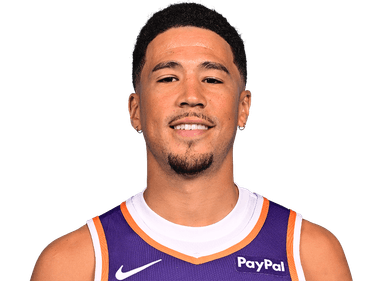
How to Guard Devin Booker
Devin does most of his damage from three-point (30.8% of his attempts) and is a limited outside shooter you can sag off. The plan below is built from where he actually shoots this season.
Where Devin scores
Share of his 2025-26 field-goal attempts by zone, with how efficiently he finishes each. This is the map the game plan is built on.
The scouting report: how to defend Devin
Contest the pull-up, do not over-help
A large share of his offense (27% of attempts) comes from the mid-range, where he shoots 46%. Stay attached and contest straight up. Loading up extra help off shooters just feeds a shot he already lives in.
Go under screens, sag into the paint
He is a lower-volume or below-average outside shooter (33.2% on 374 attempts). You can go under ball screens and sink into the paint to take away the drive and dare him to settle for the jumper.
Do not bail him out at the line
Devin gets to the free-throw line about 8.1 times a game and hits 87.3% once there. Contest straight up with a vertical hand and avoid reaching, sending him to the line is the cheapest offense he has.
Stunt and recover, do not fully help
He is a primary creator (6 assists a game), so overhelping just feeds his passing. Stunt at the ball and recover to your man rather than leaving a shooter to load up on the drive.
Pressure the handle
Devin is turnover-prone (3.1 a game). Dig at the ball on the drive and load your help early, speeding him up is where his possessions break down.
Where the ball goes when you help off Devin
His most frequent assist targets this season. When he collapses the defense, these are the outlets to rotate to first.
Quiet edges on Devin
- Barely affected by tight contests, 44.6% contested vs 43.7% open. Contest quality matters more than contest frequency.
- Extremely consistent, only 7.2 PPG standard deviation. You know what you're getting. Hard to game-plan around because he doesn't have off nights.
Get Devin's full matchup plan
The page above is the shot profile. HoopBrief turns it into a complete game plan, the exact coverage to run, on-ball positioning by spot, whistle tendencies, and the one counter to deny, in your own coaching lens.
The free scout needs no account. Full reports in the app start at $9.99/mo.
Frequently asked questions
How do you guard Devin Booker?
Contest the pull-up, do not over-help: A large share of his offense (27% of attempts) comes from the mid-range, where he shoots 46%. Stay attached and contest straight up. Loading up extra help off shooters just feeds a shot he already lives in. Go under screens, sag into the paint: He is a lower-volume or below-average outside shooter (33.2% on 374 attempts). You can go under ball screens and sink into the paint to take away the drive and dare him to settle for the jumper. Do not bail him out at the line: Devin gets to the free-throw line about 8.1 times a game and hits 87.3% once there. Cont
What is Devin Booker's biggest weakness on offense?
Relative to the rest of his shot diet, Devin is least efficient on his three-point attempts (33.2% on 374 shots this season). Steering him toward that shot, rather than the ones he makes at a high rate, is the statistical edge.
Is Devin Booker a good three-point shooter?
Devin has taken 374 three-pointers this season and made 124 of them (33.2%). That share of his offense (30.8% of his attempts) is what decides whether you chase him over screens or sag under them.
How many points per game does Devin Booker average?
Devin is averaging 26.1 points per game this season, along with 6 assists and 3.9 rebounds. Scoring volume is why he draws the defensive game plan on this page.
How to guard other players
Shot-profile and box-score figures reflect Devin Booker's 2025-26 season. Defensive recommendations are generated from that shot distribution and are teaching guidance, not a guarantee of outcome.